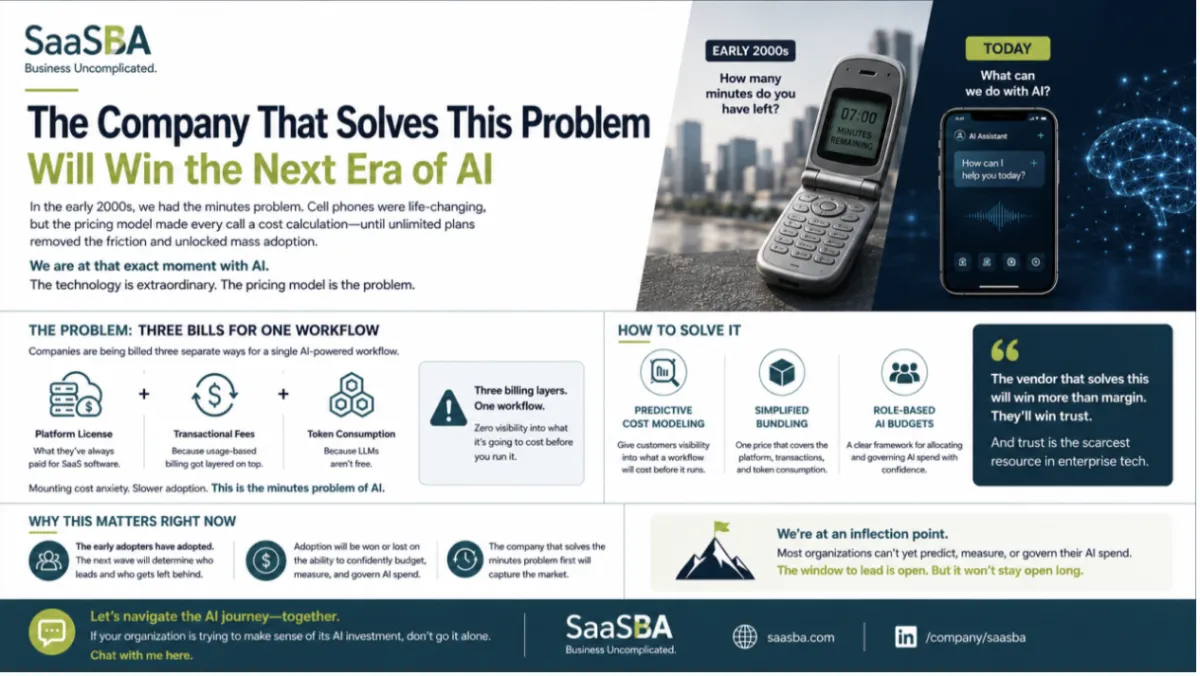
The Company That Solves This Problem Will Win the Next Era of A
There's a moment I keep thinking about from the early 2000s.
Cell phones were everywhere. Everyone had one. And everyone was obsessed with the same thing: how many minutes do you have on your plan?
You planned your calls around it. You watched the clock until 7pm. You switched carriers for a better rate. The technology was transformative, genuinely life-changing, but the pricing model turned every conversation into a cost calculation.
And then, finally, the carriers figured it out. Unlimited plans arrived, pricing became predictable, and the entire conversation shifted. Suddenly nobody was thinking about minutes anymore. They were thinking about what they could do with the phone.
The technology didn't change, but the pricing model did. And that unlock is what made mobile truly mass market.
We are at that exact moment with AI, and I see almost nobody is talking about it.
The Problem
Right now, enterprise AI has a pricing model problem that is quietly undermining everything else.
Companies are being billed three separate ways for a single AI-powered workflow. The platform license, which is what they've always paid for SaaS software. Transactional fees, because usage-based billing got layered on top. And now token consumption, because the large language models powering the AI features aren't free, and someone has to pay for them.
Three billing layers, one workflow, and zero visibility into what it's going to cost before you run it.
This is going to be more than a minor inconvenience very soon. It's a structural problem that is going to define the next phase of enterprise AI adoption.
And the companies that don't solve it are going to find themselves on the wrong side of a very uncomfortable conversation with their customers.
CFOs are already asking questions that vendors aren't prepared to answer. What are we actually spending on AI? What are we getting for it? Why can't you tell me what next month's bill is going to look like before it arrives?
Those questions are only going to get louder.
This is the minutes problem
The scuttlebutt around Silicon Valley is that usage-based pricing is the next move, and I understand why. One subscription (even a customizable one) for both the casual user and the rapidly vibe-coding startup just doesn’t work from a business standpoint.
But think about what usage-based pricing (i.e., the minutes problem) actually did to mobile adoption in the early 2000s. It didn't stop people from using phones. But it created a constant low-level friction that shaped every interaction with the technology. People self-limited. They worried. They made decisions based on cost anxiety rather than what they actually needed to do.
That's exactly what's happening with tokens right now.
Enterprise teams are making decisions about how much to use AI tools based not on what would actually move the business forward, but on a vague anxiety about what the bill might look like. Employees burn through a budget they don't fully understand and have no way to predict. IT leaders watch consumption reports they can't contextualize. CFOs approve budgets for a cost category that has no reliable forecasting model.
The technology is extraordinary. The pricing model is a problem.
And just like in the early 2000s, the company that solves this, that makes AI spend as predictable and transparent as a fixed monthly subscription, changes the entire trajectory of adoption.
How to Solve it
The solution isn't simply offering an unlimited plan. The economics of LLM consumption don't work that way, at least not yet. But there are real paths forward that nobody has fully committed to.
Predictive cost modeling (that is, giving customers visibility into what a workflow is going to consume before they run it) would fundamentally change the relationship between enterprise buyers and AI platforms. Right now you find out what something cost after the fact. Flipping that dynamic, making cost a known variable rather than a surprise, removes one of the most significant psychological barriers to adoption at scale.
Simplified bundling (that is, one price that covers the platform, the transactions, and the token consumption underneath) removes the complexity that is currently forcing finance teams to reconcile three separate cost streams for one tool.
Role-based AI budgets (giving organizations a clear framework for allocating AI spend by function, seniority, or use case) brings the kind of governance and predictability that enterprise buyers need to scale confidently rather than cautiously.
None of these are technically impossible. But they require will, architecture, and a willingness to redesign a pricing model that currently benefits the vendor more than the customer.
The vendor that makes that trade is going to win something much more valuable than short-term margin. They're going to win trust at a moment when trust is the scarcest resource in enterprise technology.
Why this matters right now
We are at an inflection point. The early adopters have adopted. But the business cases have been built and in many cases they’ve failed to deliver the returns that justified them.
The next wave of enterprise AI adoption (the wave that takes this from interesting experiment to genuine business transformation) is going to be won or lost on the question of whether organizations can confidently budget for, measure, and govern their AI spend.
Right now, most of them can't.
The minutes problem didn't last forever. The carriers that solved it first captured the market. The ones that held onto consumption-based billing as a revenue model found themselves competing on the wrong terms.
The same dynamic is coming for AI. The only question is which company sees it first and moves.
At SaaSBA, we help organizations navigate the real complexities of AI transformation from strategy and governance to adoption and ROI. If your organization is trying to make sense of its AI investment, don’t go it alone, reach out and lets ch