
The Execution Gap Killing Tech Initiatives
The strategy is solid. The roadmap is in motion. Leadership is aligned. And yet results hit a wall. Andy Worobel on the most expensive blind spot in mid-market tech — and how to close it before it costs you more.
The Execution Gap Killing Tech Initiatives
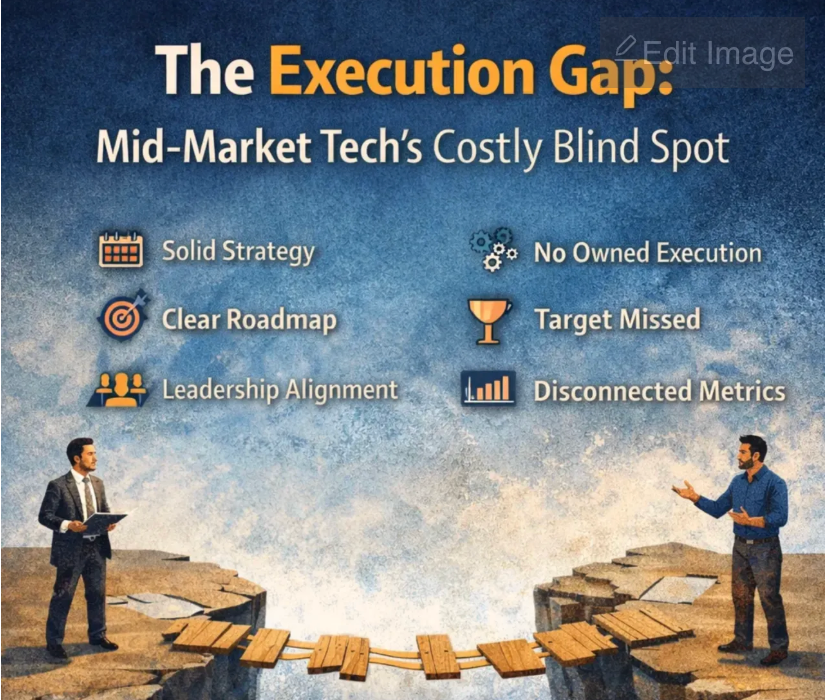
Here's a scenario we've seen repeatedly with mid-market tech leaders: the strategy is solid, the roadmap is in motion, leadership is aligned.
And yet, results hit a wall.
The initiative doesn't fail loudly — it simply underdelivers, slowly and expensively.
In almost every one of these projects, our post-mortem reveals that no one had truly owned the execution.
A Systems Problem, Not a Strategy Problem
In companies between $50M–$1B, multiple initiatives are often in flight, each dependent on complex cross-functional handoffs. And still: no single owner for delivery. No early-warning systems. Metrics that don't tie to business outcomes.
CIOs end up doing work two layers down because no one else is managing the details.
That's what I call the execution gap.
It's one of the most expensive blind spots in midsize firms.
You don't always see the cost right away. But you feel it: slow progress, low adoption, friction between teams, board updates that become performance theater, and tools that quietly gather dust.
As with almost every problem of this kind, this is a systems issue. And it's solvable.
What Closing the Execution Gap Actually Requires
Execution needs to be structured, not assumed. That means:
- Clear ownership. Someone's name is on the outcome — not a committee, not a shared inbox.
- Reporting rhythms that show signal, not just status. The difference between "we're on track" and "here's what's actually moving."
- Success metrics that align to revenue, cost, or efficiency — not task checklists.
- A change model that defines how things actually get done, across teams.
What We're Seeing in the Field
Rich and I are working with three RevOps and IT leaders right now who were in this exact place. Their strategy was sound. But delivery was stalling.
We stepped in — not to rewrite the roadmap, but to operationalize it. To bring rigor, structure, and momentum to high-stakes work.
The pattern is consistent: the gap isn't in the plan. It's in the handoff between strategy and execution. Between the slide deck and the work that actually has to happen on Tuesday morning.
The Cost of Waiting
If your initiatives are dragging or your confidence in delivery is slipping, the cost compounds every quarter you wait.
Slow progress becomes missed targets. Missed targets become board conversations you don't want to have. And tools that gather dust become budget lines that are hard to defend next cycle.
The execution gap is solvable — but it doesn't close on its own.
Schedule a call with us. We'll walk through the framework we use to close the execution gap, before it costs you more.
Explore Topics
Written by
Andy Worobel
Co-founder of SaaS Business Advisors and specialist in SaaS operations, digital transformation, and executive leadership.


