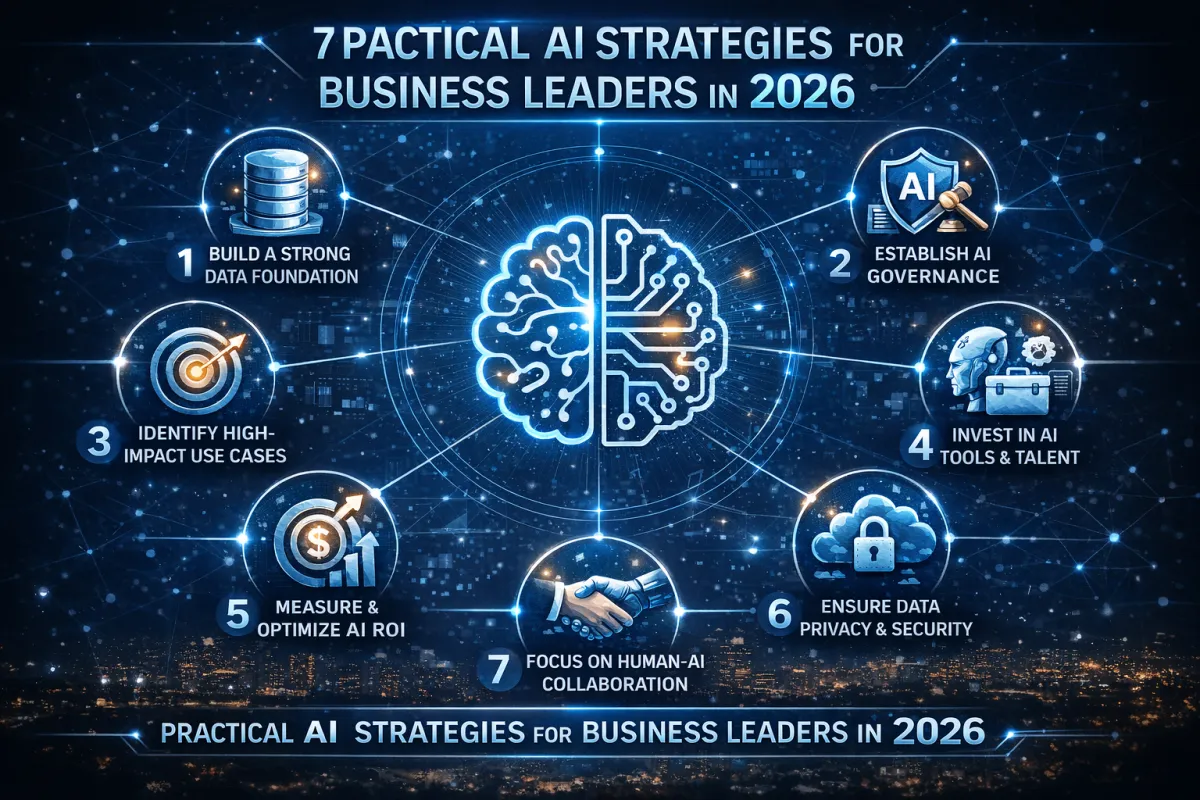
7 practical AI strategies for business leaders in 2026
Most companies are either moving too fast on AI or not moving at all. Here's what actually separates the businesses getting real ROI from artificial intelligence — and the ones burning budget on tools they don't need.
01
Start with the business problem, not the AI tool
A lot of AI implementation projects start backwards. Someone reads an article about generative AI, gets excited, buys a platform, and then figures out what to do with it. Six months later the subscription is quietly cancelled and nobody talks about it. This is one of the most common — and expensive — mistakes in enterprise AI adoption.
Before you invest in any AI tools for business, get specific: what is actually slow, broken, or expensive right now? Write it down. If you can't connect an AI initiative to that list, put it on hold. There's no shortage of artificial intelligence tools. There is a shortage of well-defined problems worth solving with them.
Worth doing:Have department heads list their top three operational headaches. Then ask, for each one: could a computer handle any part of this without someone watching it closely? That's your AI use case shortlist.
02
Your data strategy is your AI strategy
This one is uncomfortable. Most companies, when they actually audit their data, find it's messier than anyone admitted — siloed across systems, inconsistently labelled, missing huge chunks, or just wrong. Machine learning and AI don't fix that. They make it more visible and more expensive. Poor data quality is the single biggest reason AI projects fail in production.
Sorting out data infrastructure is slow and unglamorous work, which is why it keeps getting skipped. But you can't build a scalable AI strategy on top of bad data. A well-run AI pilot on clean, structured data will teach you more than a year of tinkering on messy inputs.
Concrete starting point:Pick one data source your team actually relies on — a CRM, a customer table, an inventory system. Spend a week documenting what's in it, what's missing, and who owns it. That exercise alone usually surfaces everything you need to know before investing in AI tools.
"The businesses doing well with AI aren't the ones with the most models. They tend to be the ones who built a solid data foundation first."
03
AI literacy matters more than AI certification
AI literacy in the workplace gets framed as a technical training problem, which leads to engineers getting certified in machine learning while everyone else just uses the tools and hopes for the best. That's backwards. The bigger business risk is someone in finance, legal, or operations taking AI-generated output at face value when they shouldn't.
You don't need company-wide Python courses. You need employees who can ask the right questions: where might this output be wrong? What did the model leave out? Should a human be making this call instead? Building that kind of critical thinking across your workforce is one of the most underrated AI strategies for business leaders in 2026.
Low-lift approach:A monthly 45-minute session where a team uses an AI tool together, talks through where it helped, and picks apart one case where it got things wrong. That shared experience builds real AI literacy faster than any compliance module.
04
Run a focused AI pilot before you scale
60 to 90 days, one team, one business problem, clear success metrics. That's it. Not a company-wide AI transformation programme, not a multi-year digital transformation roadmap — a bounded AI pilot you can actually learn from and measure against.
The discipline here is committing to your KPIs before you start, not after. When you define success retroactively, you find it. Define it upfront and you might discover the AI solution didn't work — which is genuinely useful information that saves you from scaling a broken process.
Keep it simple:What metric are we trying to move? By how much? By when? If you can't answer those three questions before launching an AI pilot, it isn't ready to start.
05
Human-AI collaboration beats full automation
The narrative around AI replacing jobs misses the more immediate question: which decisions should AI be involved in, and which shouldn't it? The tasks that matter most — reading a room, judging whether a customer is genuinely unhappy, deciding whether a legal argument holds — are the ones hardest to automate. AI can surface relevant information for all of those. It shouldn't be the one making the call.
The most effective AI workflows right now are hybrid: AI does the first pass, flags what's relevant, or drafts the options — and a person decides. Human-AI collaboration consistently outperforms either working alone, and it catches mistakes before they reach customers or regulators.
A practical rule for responsible AI:Any business decision that would require an apology if it went wrong should have a human signing off on it. Automate the routing. Keep a person on the judgement call.
06
AI governance: build it before a regulator forces you to
The EU AI Act is already in force. Sector-specific AI regulations in financial services, healthcare, and hiring are tightening across multiple jurisdictions. AI compliance isn't speculative — it's happening now, and businesses caught without documentation or clear AI governance structures are going to face real legal and reputational exposure.
The good news is that AI governance built early is significantly cheaper and less disruptive than governance bolted on under regulatory pressure. You don't need a 60-page AI policy on day one. You need a model registry, an AI use policy, and a named person accountable for AI-driven decisions. That's your minimum viable AI governance framework.
Start here:Know what AI systems you're running, what business decisions they're involved in, and who is accountable if something goes wrong. If you can't answer those three questions today, AI governance is your most urgent priority.
07
AI model performance degrades. Monitor it continuously.
AI systems don't stay accurate over time. The world changes, your customer data changes, market conditions change — and an AI model that performed well six months ago may be quietly producing worse outputs without anyone noticing. Model drift is one of the most underappreciated operational risks in production AI, and one of the most common causes of poor AI ROI.
Build continuous AI monitoring into every deployment from the start. Review outputs regularly, collect feedback from the employees actually using the system, and schedule quarterly model audits. The AI ROI conversation belongs at the board level, not buried in an IT report — if artificial intelligence is touching your revenue or operations, leadership should be tracking what it's doing.
Key AI metrics to track:Time saved per task, error rate before and after deployment, cost per automated decision, and actual usage rates. Low adoption is usually the first sign an AI implementation is failing.
The bottom line
Successful AI adoption in business doesn't require the biggest budget or the most sophisticated technology. The companies consistently getting real ROI from artificial intelligence are the ones doing the unglamorous groundwork first: a clear problem statement, clean data, a properly scoped AI pilot, defined success metrics, and humans still in the loop on decisions that matter. They treat AI governance as a business requirement, not a compliance afterthought. And they keep watching their models after deployment — because AI that works today won't necessarily work next quarter.
AI strategy isn't a one-time project. It's an operational capability you build over time. Start with one item on this list. Do it properly. Then move to the next. That's how the companies quietly winning with AI are actually doing it.