What Should Be in Your AI Governance Framework (A Mid-Market Guide)
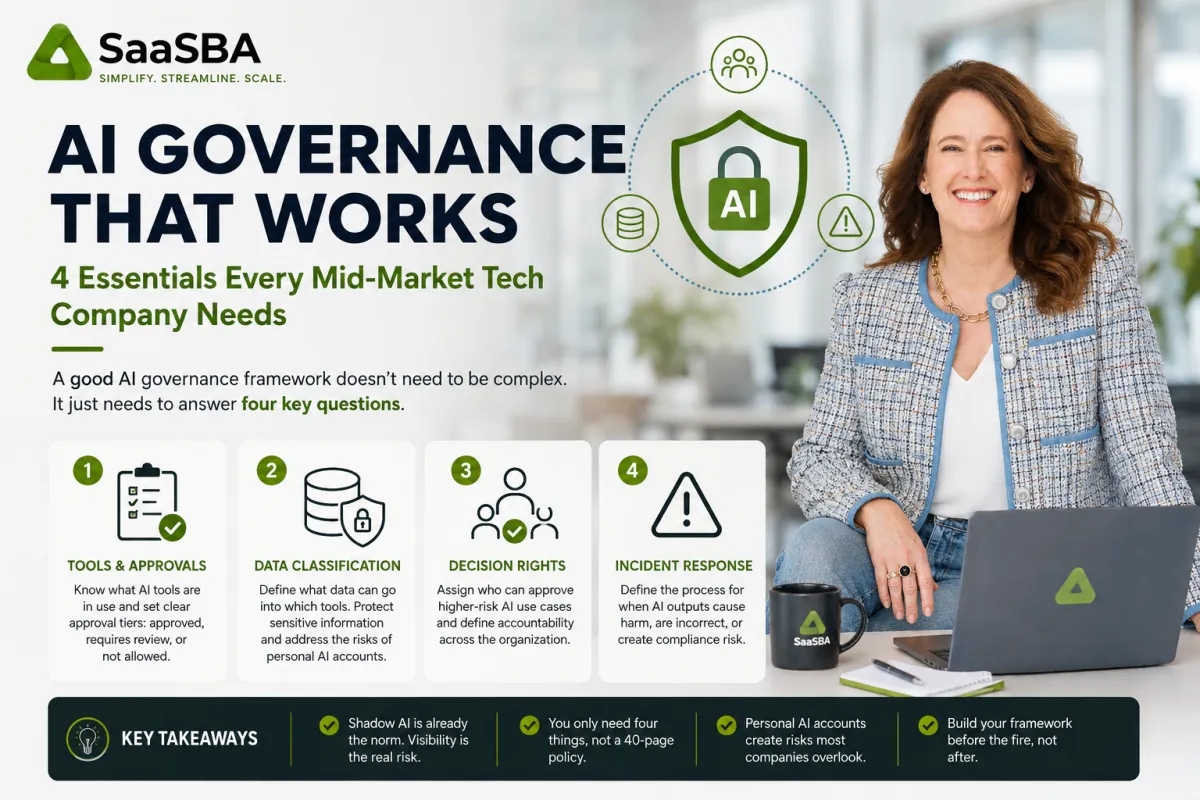
A good AI Governance Framework for a mid-market tech company should include an AI tool inventory and approval tiers, a data classification policy for what can go into which tools, clear decision rights for higher-risk AI use cases, and a defined response process for when something goes wrong.
Key Takeaways
Shadow AI is already the norm. Most employees are using AI tools their company never approved, and most companies have no way to detect or manage it. That lack of visibility, not the tools themselves, is the real risk.
You only need four things, not a 40-page policy. A usable framework answers: what tools are approved, what data can go into them, who approves higher-stakes use, and what happens when something goes wrong.
Personal AI accounts are a bigger risk than most companies realize. If employees are using their own ChatGPT or Claude subscriptions for work, there's no enterprise agreement governing how that data gets used or retained, by default.
Build your framework before the fire, not after. Reactive governance (write a policy after something breaks) is far weaker than a framework built proactively, and a lean version is achievable in weeks without a dedicated AI ethics team.
Every company we talk to says the same thing eventually: "We know we need an AI governance framework, but we don't know what's actually supposed to be in it."
Most of what gets written about AI governance is built for enterprises with dedicated compliance teams, general counsel on retainer, and a Chief AI Officer – which leaves out a large section of the market.
If you're a 200-to-2,000-person company, that model doesn't fit you, and trying to force it usually means governance never gets built at all.
So here's a guide for what an AI governance framework should actually include if you're a mid-market company. Not a theoretical version, a usable one.
Why This Matters
Shadow AI (which means employees using AI tools your company never approved, on data your company never cleared) is already the norm.
Recent industry surveys put the number of employees using unapproved AI tools well above half, while the share of companies with any policy to detect or manage it remains a small minority.
This lack of visibility is the actual risk, moare than the AI tool itself. The fact that nobody in the company can say with confidence what's being used, by whom, on what data opens your company up for inneficiency at best, data breaches at worst.
Governance is about being able to answer basic questions when someone (a board member, a customer, a regulator) asks them. Right now, most mid-market companies can't.
The four things a mid-market AI governance framework needs
You don't need a 40-page policy manual to have a good framework (in fact, something that long is probably a bad framework, because no one will read it.)
All you need clear answers to four questions, documented, communicated, and revisited on a regular cadence.
1. What tools are your people allowed to use?
Start with an inventory. You cannot govern a tool you don't know exists, and most companies are surprised by how many AI-enabled tools are already running inside their teams. Importantly, this isn't a one-time exercise. New AI features are getting bolted onto existing SaaS tools constantly, often without anyone in IT signing off.
Once you know what's in use, you need a simple approval tier: what's pre-approved for anyone to use, what requires manager sign-off, and what's off-limits entirely. Most companies overcomplicate this. It doesn't need to be complicated, it only needs to exist.
2. What data can go into those tools?
This is where the real risk lives. Data classification doesn't need to be elaborate; public information, internal information, and sensitive/regulated information is often enough of a starting taxonomy for most mid-market companies.
The policy question is simple: which tiers of data are allowed in which tools? And who decides when something new comes up?
This is where to deal with the issue of personal AI accounts. If an employee is using their own ChatGPT or Claude subscription for work, your company has no enterprise agreement governing how that data gets used or retained.
That's a pretty substantial risk.
3. Who approves AI use for higher-stakes decisions?
Not every AI use case carries the same risk. A tool that summarizes internal meeting notes is a different category than a tool influencing hiring decisions, credit decisions, or anything touching regulated data.
A workable framework tiers these by risk and assigns clear decision rights to each tool. Who can approve a low-risk internal tool? And who needs to sign off before AI touches something customer-facing, HR-adjacent, or financially material?
This is also where accountability gets assigned – not necessarily to a single owner, but to a clear structure. Some companies centralize this under IT or a CIO. Others build a small cross-functional committee.
What matters is that the decision rights are documented and known, rather than defaulting to whichever team adopted a tool first.
4. What happens when something goes wrong?
Every framework needs an answer to this, and most don't have one until after the first incident. What's the process when an AI tool produces something inaccurate, biased, or harmful? Who gets notified, how fast, and what's the remediation path? This needs to exist before you need it, not after.
What comes after the baseline
Once these four areas are documented, a few things tend to follow naturally:
Vendor evaluation.
Before your next AI tool purchase, a lightweight scorecard covering data handling, security posture, and contract terms around training data prevents a lot of the mess that shows up later.
Regular review.
AI governance is a living document. Tools change, risk profiles change, and a framework that isn't revisited quarterly is a framework that's quietly going stale. You’re going to need to revisit.
Connection to your AI roadmap.
Governance works best when it's tied to your broader AI prioritization. Knowing which use cases you're pursuing makes it much easier to know which risks actually matter for your company. This keeps you from governing hypothetically.
Common mistakes
Most companies build AI governance reactively: something goes wrong, gets complicated, or gets expensive, and then a policy gets written to address that one specific problem.
This, of course, works about as well as installing a smoke detector after there’s been a fire.
A governance framework built before the problems gives your team clear guidance on what they can and can't do, protects the company from legal and reputational exposure, and makes sure AI investment decisions are evaluated consistently instead of case by case.
You don't need a dedicated AI ethics function to do this well. What you do need is clear ownership, a simple risk tiering system, and a habit of revisiting both as your AI use grows.
That's achievable in weeks, not quarters, and it's a far better position to be in than explaining, after the fact, why nobody was watching.
If you're building an AI roadmap for your company and governance isn't part of the plan yet, it should be. It's the layer that keeps everything else, prioritization, investment, adoption, from becoming its own liability. Set up a free call with us, and we can help.