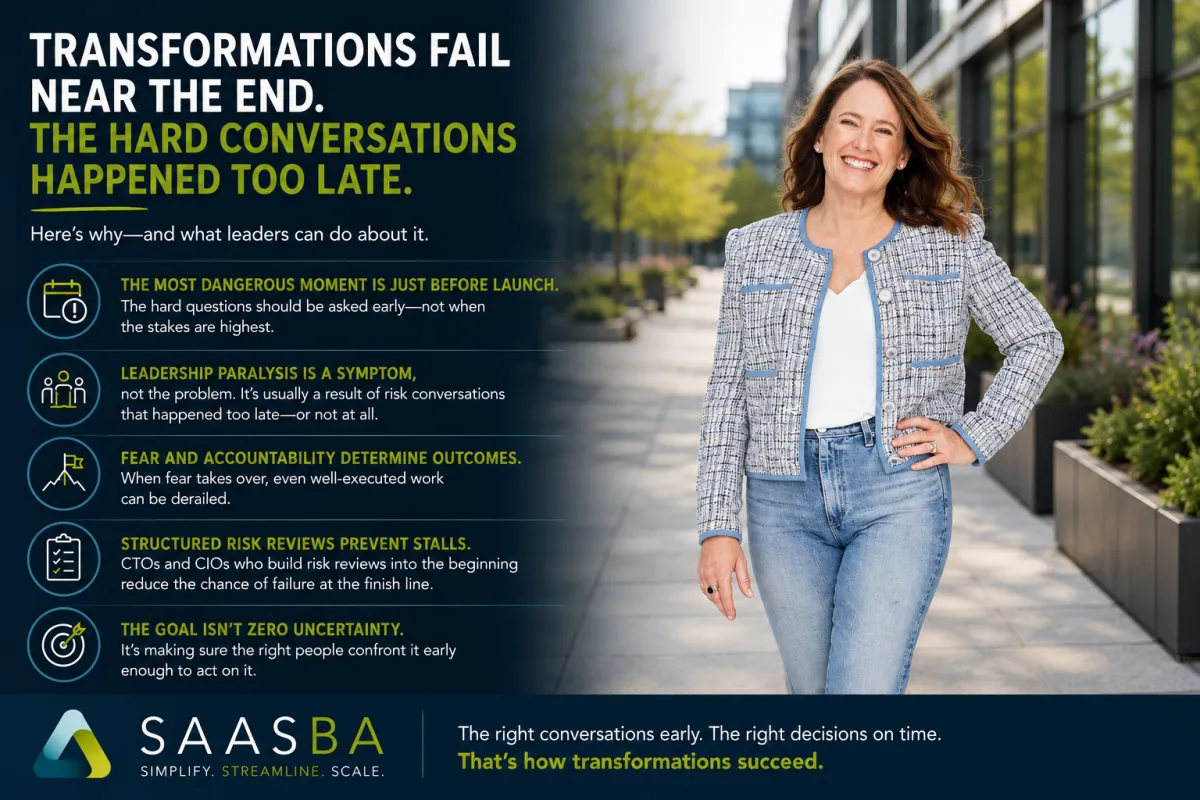
Why Digital Transformations Fail at the Finish Line
And What Leaders Can Do About It
Especially in legacy businesses, tech transformations fail near the end because the hard conversations happened too late. This article is a summary of why, where the most common pitfalls are, and how your executive team can avoid them.
Key Takeaways
The most dangerous moment in a digital transformation is just before the launch because often, nobody asked the hard questions until the stakes were too high to answer them honestly.
Leadership paralysis at go/no-go is almost always a symptom of risk conversations that should have happened months earlier
Fear and accountability are powerful forces. When they show up late in a project, they derail even well-executed work
CTOs and CIOs who build structured risk reviews into the beginning of a project dramatically reduce the likelihood of a stalled or failed transformation
The goal isn't to eliminate uncertainty. It's to make sure the right people have confronted it early enough to act on it
Digital transformation failure is rarely a technology problem.
I've spent years working inside complex transformation projects, ERP implementations, data modernization efforts, commercial platform builds, and the pattern I see most often isn't a bad technology choice or a blown budget.
Instead, I usually see leadership teams that ran out of courage at exactly the wrong moment.
That looks something like:
Multiple go/no-go meetings.
The final checkpoint before launch.
The moment when months of work either move forward or grind to a halt.
Increasingly, that's where projects go to die.
Not because the work was bad or the team wasn't ready, but because the hard questions that should have been asked at the beginning of the project are suddenly being asked at the end, when the stakes are highest, the pressure is greatest, and fear has completely overtaken accountability.
What leadership paralysis actually looks like
Leadership paralysis rarely announces itself. It doesn't show up as a dramatic confrontation or a clear decision to stop.
Usually, it shows up as delay.
Suddenly there are new requirements that weren't in the original scope. Concerns are raised that were never mentioned in any prior review. Stakeholders who signed off on the approach six months ago are now questioning the fundamentals. And the team, who has been heads-down building something real, finds itself in an endless loop of justification, revision, and re-review.
I was in exactly this situation recently. A project that had been in go/no-go for over a month because leadership had never been forced to confront those risks early on (when it would have been easier to address them.) So, they were confronting them now, under pressure, with a live system waiting to launch.
The results? Nothing good.
New objections surfaced weekly. Goalposts shifted. Requirements that had never appeared in any documentation suddenly became blockers. At the risk of sounding harsh: the leadership had failed their team, and the team was bearing the brunt of the consequences.
Why fear shows up late
Here's what I've come to understand after years of working through this: fear doesn't show up at the beginning of a transformation because the beginning feels safe. The project is still theoretical. The risks are still abstract. There's plenty of time to figure it out.
So the hard conversations get deferred. Risk reviews get skimmed. The quality team and the commercial team never sit in the same room to reconcile their assumptions. The CTO signs off on a roadmap without fully understanding what the business side is expecting to see on day one.
And then go/no-go arrives.
Now the risks are no longer abstract. The system is real. The launch date is real. The implications of being wrong are real. And suddenly everyone who quietly held reservations for the past six months decides this is the moment to voice them.
That's not diligence. That's fear wearing the costume of accountability.
The accountability gap
There's an important distinction worth making here, because fear and accountability are often confused, especially in high-stakes project environments.
Accountability means understanding the risks, owning your part in managing them, and making a decision with the information available. It's uncomfortable, but it moves things forward.
Fear means looking for reasons not to decide. It manufactures new requirements. It asks for more data when the data already exists. It defers to other stakeholders, escalates to committees, and finds procedural reasons to delay the inevitable.
The tragedy is that both can look identical from the outside. A leader raising a legitimate concern and a leader stalling out of fear will often use the exact same language. The difference is in what they're actually willing to do about it.
CTOs and CIOs are in a unique position here. You sit at the intersection of technology and business outcomes. You understand both the capability of the system and the organizational readiness required to use it. That means you have both the authority and the obligation to call this dynamic out, and to build the kind of project structure that prevents it from happening in the first place.
What should have happened at the beginning
The antidote to late-stage leadership paralysis isn't a better go/no-go framework. It's doing the hard work earlier.
Specifically, it means building structured risk and assumption reviews into the earliest phases of the project, not as a checkbox exercise, but as a genuine cross-functional conversation.
Here's what that looks like in practice:
Bring the commercial team and the technical team into the same room before a single line of code is written or a single vendor is selected. Not to align on vision, that comes later. First, ask them to surface every risk, dependency, and assumption they're each working with. Make it explicit. Write it down. Pressure-test it together.
Then ask the harder question: where do our assumptions conflict?
In my experience, this is where the real work happens. The commercial team assumes the data will be clean enough to use on day one. The technical team knows it won't be. The quality team assumes the commercial team will follow a strict approval process. The commercial team has no idea that process exists. These gaps don't go away by themselves. They just go underground, where they quietly undermine everything built on top of them.
Surfacing them early doesn't eliminate the tension. But it gives the leadership team a fighting chance to resolve it before it becomes a launch blocker.
The role of the CTO in preventing transformation failure
Digital transformation failure at the go/no-go stage is, ultimately, a leadership accountability problem. And while it involves the full executive team, the CTO is often best positioned to prevent it.
Not by controlling the process, but by modeling the behavior. By being the person in the room who asks the uncomfortable question in month two instead of month eight. By building a project culture where risk is something you name and manage, not something you hope doesn't come up.
The best technology leaders I've worked with share one trait: they're genuinely comfortable with uncertainty. They don't need the path to be clear before they're willing to move. They need the risks to be known, the assumptions to be tested, and the team to be aligned on what they're going to do when things don't go as planned.
That's not optimism. That's discipline. And it's the single biggest predictor of whether a transformation succeeds or stalls at the finish line.
The bottom line
Digital transformation failure doesn't usually happen because the technology was wrong. It happens because the hard conversations were deferred until the cost of having them became almost unbearable.
Go/no-go paralysis is a symptom. The disease is a project culture that treats risk as something to manage later, until later arrives, and there's no good way to manage it at all.
The fix is uncomfortable, but not complicated. The most important part is to start at the beginning.
Frequently Asked Questions
What is the most common reason digital transformations fail?
The most common reason isn't a technology failure. It's a leadership failure. Specifically, it's the failure to surface and resolve organizational risks, misaligned assumptions, and cross-functional conflicts early enough in the project to address them effectively. By the time these issues appear at go/no-go, they're far more expensive and disruptive to resolve.
What is a go/no-go decision in a digital transformation project?
A go/no-go decision is a formal checkpoint, typically near the end of a project, where leadership decides whether to proceed with a launch or delay it. When managed well, it's a structured final review. When managed poorly, it becomes the moment where previously unspoken concerns surface all at once, often stalling or derailing work that was otherwise ready to launch.
How can CTOs prevent leadership paralysis at go/no-go?
The most effective approach is to build structured risk and assumption reviews into the earliest phases of the project. This means bringing cross-functional stakeholders together before development begins, making risks explicit, and creating a project culture where uncertainty is named and managed rather than deferred. Leaders who do this consistently find that go/no-go becomes a confirmation, not a crisis.
What is the difference between fear and accountability in project leadership?
Accountability means owning the risks, making decisions with the available information, and moving the work forward. Fear, even when it looks like diligence, means manufacturing new requirements, deferring decisions, and finding procedural reasons to delay. Both can use identical language, which is why it's important for senior leaders to develop the self-awareness to distinguish between the two in themselves and their teams.
How long should a go/no-go process take?
A well-structured go/no-go review should take days, not weeks or months. If a go/no-go process is extending beyond two weeks, it's usually a sign that the underlying risks were never properly addressed earlier in the project, and that the decision-making process has become a proxy for unresolved organizational conflict.
What role does organizational alignment play in digital transformation success?
It's foundational. The most technically sound transformation will stall if the commercial team, IT team, and quality or compliance functions are operating under conflicting assumptions about what the project is supposed to achieve. Alignment isn't a one-time kickoff conversation. It's an ongoing discipline that has to be built into the project structure from day one.