The AI “Unknown Unknowns” That Will Bite You Later
Every CEO I talk to knows the known unknowns of AI.
These are the things you feel ready to tackle: the architecture questions, CEO expectations, board scrutiny, and (of course) the “are we replacing jobs?” panic.
That’s table stakes. They’re visible risks, and most CIOs know they’ll need to make a plan for this.
But the thing really keeping execs up at night is the stuff no one wanted to look at.
The “unknown unknowns” that we don’t know how to predict.
And nine times out of ten, these types of problems are human, not AI
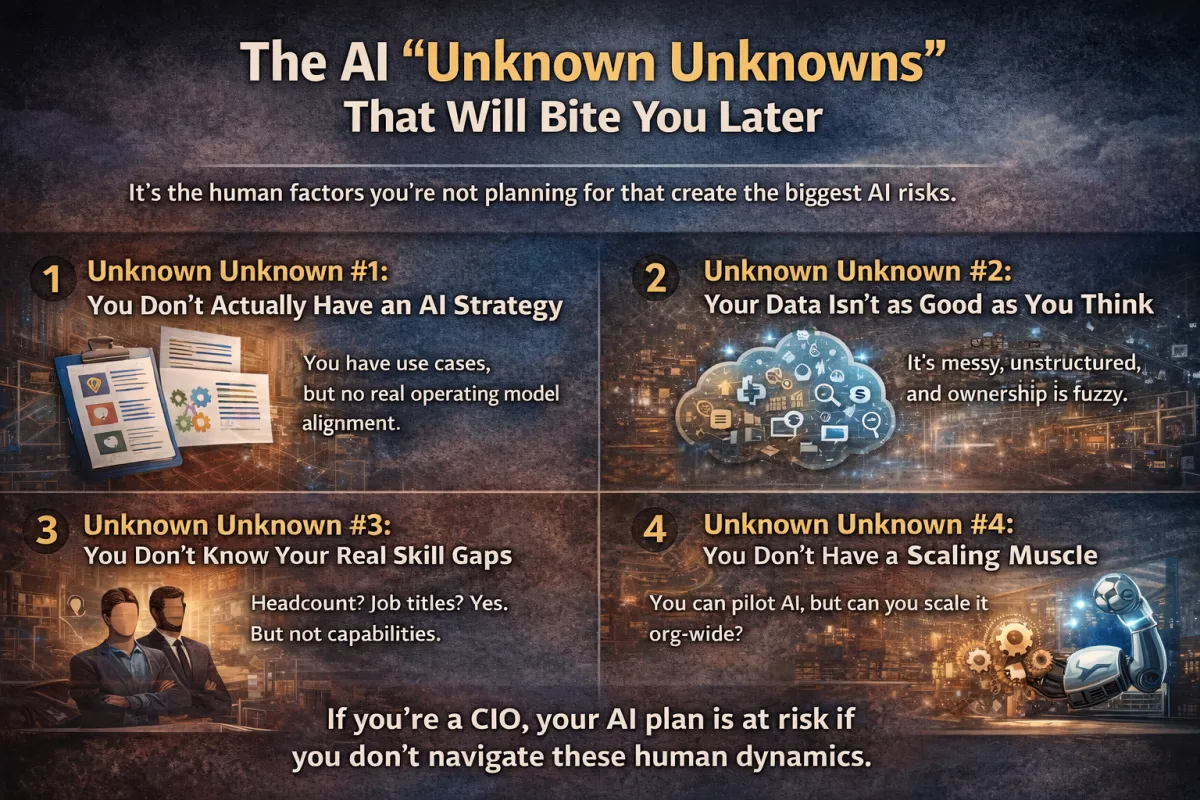
Unknown Unknown #1: You Don’t Actually Have an AI Strategy
You have use cases, but that’s not the same thing.
If AI isn’t directly tied to your 3-5 year operating model, your margin targets, your customer experience design, then it’s just experimentation with a budget.
The silent killer here is alignment.
Your team may be nodding in meetings and still have no idea what this initiative actually means for how they work.
That gap won’t show up in early status reports, but it will be all too obvious when adoption stalls out in 3-6 months.
Unknown Unknown #2: Your Data Isn’t as Good as You Think
Every company says their data is “pretty solid.”
And then AI hits it. Then suddenly, ownership is fuzzy, definitions don’t match, and governance is theoretical.
AI does not clean up messy foundations. It magnifies them.
And once trust in the output erodes, so does trust in the initiative.
One of your very first steps in AI transformation is to get absolutely granular about the quality of your data. Before you start implementing something new.
Unknown Unknown #3: You Don’t Know Your Real Skill Gaps
This is the one no one likes. You know headcount, and you know job titles.
But do you know capability? Can you show:
What skills your future state requires?
Where you’re strong and where you’re thin?
Who is compensating for weak process?
Most can’t. So when adoption lags, it gets labeled “resistance.”
Sometimes it’s not resistance. Sometimes it’s misalignment, or fear, or a department that’s been relying on one person for the last decade.
If you’re a CIO, you almost always have skill and talent gaps you don’t know to account for. You need to plan for this as you prepare for AI implementation.
Unknown Unknown #4: You Don’t Have a Scaling Muscle
Pilots are easy. Every roadmap has them.
But an org-wide AI transformation requires clear ownership, governance that evolves, metrics tied to business value, cross-functional accountability.
If you miss one of these, you get a shiny spectacle for 1-2 quarters, and then absolute silence when the board starts asking about ROI.
Does your plan include what happens after org-wide adoption? Do you have an idea of what happens as technology changes? If not, you are already planning for a stallout.
The Adoption Pattern
CIOs are not naïve. You know the pressure. You know the risks.
But the biggest predictor of success readiness across four dimensions:
Strategy & Vision
Data & Infrastructure
Talent & Skills
Experimentation & Delivery
Notice: all of these are problems with humans, not with tech stack. When one of these areas is soft, AI exposes it. When two are soft, the initiative drifts.
When three are soft, you’re in trouble.
If you’re feeling like there are “unknown unknowns” in your AI plan, you’re probably right.
The good news: you can put them in the “known unknown” column now.