AI Won't Ask for Permission. The Question Is What You Do Next.
AI is everywhere. It's in your inbox, your boardroom, your kids' classrooms, your doctor's office, and your Netflix queue. Thousands of AI companies are sprouting up overnight, and venture capital poured a record $109 billion into AI in the United States alone in 2024 — twelve times more than China. The pace of change is unlike anything we've seen before.
A little dramatic? Maybe. But entirely justified.
We've always seen technology reshape how we live and work. Factory automation. The personal computer. The internet. Each wave brought disruption, fear, and ultimately transformation. But those waves unfolded over decades. AI is moving in years — sometimes months. The rules are being rewritten before most of us even learned to play the old game.
And here's what makes this moment truly different: it's not just the technology. It's who controls it. We're watching companies post record profits while CEOs earn more than 1,000 times the average worker's salary — and in the same breath announce sweeping layoffs.
In 2025 alone, nearly 55,000 U.S. job cuts were directly attributed to AI, according to Challenger, Gray & Christmas. Workday, Microsoft, Salesforce, IBM — the names keep coming. Workers aren't wrong to wonder if "efficiency" is just a more palatable word for elimination.
But the real story, as always, is more complicated.
Oxford Economics found that, despite the headlines, AI-attributed job losses represent only 4.5% of total reported U.S. layoffs — and suspects many companies are simply "dressing up" standard headcount reductions as AI-driven transformation. Goldman Sachs economists, meanwhile, found no statistically significant correlation between AI exposure and unemployment rates in current macro data. The displacement is real in pockets — early-career tech workers, entry-level white-collar roles — but the revolution hasn't hit the broader labor force yet.
What has hit is the promise. And the peril.
So let's examine both honestly.
5 Ways AI Is Working Against Us
1. Skill Decay — You're Outsourcing the Reps That Build You
When you started your career, you had to learn the ropes. No matter how smart you were in school, you needed to understand how the company worked, earn your stripes, and figure things out the hard way. All of that is now being replaced by AI — ingesting large quantities of data and delivering the answers instantly. No one has to learn the ropes anymore. They just chat. The reality is companies are already feeling this — entry-level employees aren't doing the rough work that builds future leaders. 40% of employers globally expect to reduce headcount because of AI (WEF, 2025) — but cutting people before building what replaces them is just trading short-term savings for long-term fragility.
2. Trust Erosion — Seeing Is No Longer Believing
Where has your voice gone? Do we want a flood of AI-generated content, or do we want authentic voices — real ideas, real perspectives? And once we do have something original, is it just cloned the moment it hits the world? How can we trust something so lifelike? Deception is everywhere and it's becoming harder to know what's genuinely yours and what's AI-generated. When anyone can produce polished content in seconds, looking professional is table stakes, not differentiation. Trust is the new moat — and most companies aren't protecting it.
3. Data Exposure — Convenience Is a Risk You're Not Pricing
As technology has improved, our data has become less and less secure, and governments and companies are doing little to truly protect it. People spent $213 billion in 2025 on data privacy software and cybersecurity — that's big business. The challenge is that employees and individuals are pasting contract clauses, client details, financial breakdowns, and personal data into AI prompts every day because it's faster — without knowing whether that data is protected. That leaves enormous risk on the table. Data governance is no longer an IT conversation. It's a liability conversation. When data leaves your ecosystem, control leaves with it.
4. Strategic Drift — When Everyone Uses the Same Model, Everyone Gets the Same Answer
Strategy has always been a complicated process — it requires conversation, debate, and rigorous analysis. AI is streamlining a number of those steps, but it's also shaping how problems are framed in the first place. When leadership teams lean too heavily on AI-generated analysis without challenging the inputs, strategy converges. Everyone using similar tools starts reaching similar conclusions. Differentiation erodes quietly, without anyone noticing until it's too late. AI should inform decisions. It shouldn't make them.
5. Psychological Toll — The Anxiety Is Real and It's Spreading
When AI can produce in seconds what used to take you hours, the question "where do I fit?" isn't irrational — it's human. Workers aged 18–24 are 129% more likely than those over 65 to worry AI will make their job obsolete. Nearly 49% of Gen Z job seekers believe AI has reduced the value of their college education. That anxiety doesn't stay personal — it shows up as disengagement, defensive behavior, and cultural stagnation inside organizations. AI is reshaping the culture of how we work, and leaders are at risk of losing what makes teams great: the human connections that no model can replicate.
5 Ways AI Is Working For Us
1. Leverage That Used to Cost a Team
An army of one. One person with the right AI tools now has the output capacity of a small team. Research, drafting, analysis, prototyping — leveraging information at speed allows us to move through analysis and into decision-making in days, not months. That means smaller teams producing bigger results. For startups, it means competing with the big players at a fraction of the cost and overhead. Companies using AI with full end-to-end integration are seeing cost savings up to 25% (McKinsey). That changes the game and gives everyone a real shot at competing for customers.
2. A Thinking Partner That's Always Available
Human + AI = Superpowers. When harnessed correctly, AI doesn't replace your thinking — it accelerates it. It pressure-tests assumptions, synthesizes information across domains, and shortens the gap between curiosity and competence. It lets you brainstorm and course-correct at a speed you couldn't manage before. Goldman Sachs projects AI could boost U.S. labor productivity by 15% at full adoption and raise global GDP by 7% — nearly $7 trillion in added economic activity. The upside is real, and if invested in properly and managed well, you will lead your competition.
3. Expertise That Used to Be Gated Is Now Accessible
You now have access to skills that used to require degrees and years of experience. You have an assistant with the knowledge of the world at their digital fingertips — a designer, a coder, a copywriter — tools that were once completely out of reach. That unlocks innovation for individuals and organizations alike, delivering real results in record time. Sales professionals using AI report 47% higher productivity, saving around 12 hours per week — and 83% of AI-enabled sales teams saw revenue growth in 2024, compared to 66% without it. The question now is: are you an AI learner or a follower?
4. The Operational Drag Is Gone — If You Let It Be
The future is automated, and the delay between tasks and outcomes is becoming almost nonexistent. AI is working 24/7 on the repetitive work — scheduling, summarizing, parsing documents, generating reports. These are the tasks that create friction and slow businesses down every day. Automate them and you free people to focus on high-value work instead of drowning in admin. AI reduces customer service costs by 30% on average, and companies using it in marketing report a 37% drop in costs alongside a 39% lift in revenue. Efficiency done right doesn't eliminate people — it elevates them.
5. The Creative Ceiling Just Got Higher
Now you can be both creative and analytical — with your AI partner. It surfaces ideas you wouldn't have considered, suggests angles you hadn't tried, and lets you iterate faster so experimentation becomes part of the process rather than a luxury. The creative process is faster. For businesses, that means more pilots, faster failure, less time and money wasted on bad strategy and design, and more innovation at lower cost. The ceiling rises because the cost of trying things drops.
AI Won't Ask for Permission. The Question Is What You Do Next.
AI is everywhere. It's in your inbox, your boardroom, your kids' classrooms, your doctor's office, and your Netflix queue. Thousands of AI companies are sprouting up overnight, and venture capital poured a record $109 billion into AI in the United States alone in 2024 — twelve times more than China. The pace of change is unlike anything we've seen before.
A little dramatic? Maybe. But entirely justified.
We've always seen technology reshape how we live and work. Factory automation. The personal computer. The internet. Each wave brought disruption, fear, and ultimately transformation. But those waves unfolded over decades. AI is moving in years — sometimes months. The rules are being rewritten before most of us even learned to play the old game.
And here's what makes this moment truly different: it's not just the technology. It's who controls it. We're watching companies post record profits while CEOs earn more than 1,000 times the average worker's salary — and in the same breath announce sweeping layoffs.
In 2025 alone, nearly 55,000 U.S. job cuts were directly attributed to AI, according to Challenger, Gray & Christmas. Workday, Microsoft, Salesforce, IBM — the names keep coming. Workers aren't wrong to wonder if "efficiency" is just a more palatable word for elimination.
But the real story, as always, is more complicated.
Oxford Economics found that, despite the headlines, AI-attributed job losses represent only 4.5% of total reported U.S. layoffs — and suspects many companies are simply "dressing up" standard headcount reductions as AI-driven transformation. Goldman Sachs economists, meanwhile, found no statistically significant correlation between AI exposure and unemployment rates in current macro data. The displacement is real in pockets — early-career tech workers, entry-level white-collar roles — but the revolution hasn't hit the broader labor force yet.
What has hit is the promise. And the peril.
So let's examine both honestly.
5 Ways AI Is Working Against Us
1. Skill Decay — You're Outsourcing the Reps That Build You
When you started your career, you had to learn the ropes. No matter how smart you were in school, you needed to understand how the company worked, earn your stripes, and figure things out the hard way. All of that is now being replaced by AI — ingesting large quantities of data and delivering the answers instantly. No one has to learn the ropes anymore. They just chat. The reality is companies are already feeling this — entry-level employees aren't doing the rough work that builds future leaders. 40% of employers globally expect to reduce headcount because of AI (WEF, 2025) — but cutting people before building what replaces them is just trading short-term savings for long-term fragility.
2. Trust Erosion — Seeing Is No Longer Believing
Where has your voice gone? Do we want a flood of AI-generated content, or do we want authentic voices — real ideas, real perspectives? And once we do have something original, is it just cloned the moment it hits the world? How can we trust something so lifelike? Deception is everywhere and it's becoming harder to know what's genuinely yours and what's AI-generated. When anyone can produce polished content in seconds, looking professional is table stakes, not differentiation. Trust is the new moat — and most companies aren't protecting it.
3. Data Exposure — Convenience Is a Risk You're Not Pricing
As technology has improved, our data has become less and less secure, and governments and companies are doing little to truly protect it. People spent $213 billion in 2025 on data privacy software and cybersecurity — that's big business. The challenge is that employees and individuals are pasting contract clauses, client details, financial breakdowns, and personal data into AI prompts every day because it's faster — without knowing whether that data is protected. That leaves enormous risk on the table. Data governance is no longer an IT conversation. It's a liability conversation. When data leaves your ecosystem, control leaves with it.
4. Strategic Drift — When Everyone Uses the Same Model, Everyone Gets the Same Answer
Strategy has always been a complicated process — it requires conversation, debate, and rigorous analysis. AI is streamlining a number of those steps, but it's also shaping how problems are framed in the first place. When leadership teams lean too heavily on AI-generated analysis without challenging the inputs, strategy converges. Everyone using similar tools starts reaching similar conclusions. Differentiation erodes quietly, without anyone noticing until it's too late. AI should inform decisions. It shouldn't make them.
5. Psychological Toll — The Anxiety Is Real and It's Spreading
When AI can produce in seconds what used to take you hours, the question "where do I fit?" isn't irrational — it's human. Workers aged 18–24 are 129% more likely than those over 65 to worry AI will make their job obsolete. Nearly 49% of Gen Z job seekers believe AI has reduced the value of their college education. That anxiety doesn't stay personal — it shows up as disengagement, defensive behavior, and cultural stagnation inside organizations. AI is reshaping the culture of how we work, and leaders are at risk of losing what makes teams great: the human connections that no model can replicate.
5 Ways AI Is Working For Us
1. Leverage That Used to Cost a Team
An army of one. One person with the right AI tools now has the output capacity of a small team. Research, drafting, analysis, prototyping — leveraging information at speed allows us to move through analysis and into decision-making in days, not months. That means smaller teams producing bigger results. For startups, it means competing with the big players at a fraction of the cost and overhead. Companies using AI with full end-to-end integration are seeing cost savings up to 25% (McKinsey). That changes the game and gives everyone a real shot at competing for customers.
2. A Thinking Partner That's Always Available
Human + AI = Superpowers. When harnessed correctly, AI doesn't replace your thinking — it accelerates it. It pressure-tests assumptions, synthesizes information across domains, and shortens the gap between curiosity and competence. It lets you brainstorm and course-correct at a speed you couldn't manage before. Goldman Sachs projects AI could boost U.S. labor productivity by 15% at full adoption and raise global GDP by 7% — nearly $7 trillion in added economic activity. The upside is real, and if invested in properly and managed well, you will lead your competition.
3. Expertise That Used to Be Gated Is Now Accessible
You now have access to skills that used to require degrees and years of experience. You have an assistant with the knowledge of the world at their digital fingertips — a designer, a coder, a copywriter — tools that were once completely out of reach. That unlocks innovation for individuals and organizations alike, delivering real results in record time. Sales professionals using AI report 47% higher productivity, saving around 12 hours per week — and 83% of AI-enabled sales teams saw revenue growth in 2024, compared to 66% without it. The question now is: are you an AI learner or a follower?
4. The Operational Drag Is Gone — If You Let It Be
The future is automated, and the delay between tasks and outcomes is becoming almost nonexistent. AI is working 24/7 on the repetitive work — scheduling, summarizing, parsing documents, generating reports. These are the tasks that create friction and slow businesses down every day. Automate them and you free people to focus on high-value work instead of drowning in admin. AI reduces customer service costs by 30% on average, and companies using it in marketing report a 37% drop in costs alongside a 39% lift in revenue. Efficiency done right doesn't eliminate people — it elevates them.
5. The Creative Ceiling Just Got Higher
Now you can be both creative and analytical — with your AI partner. It surfaces ideas you wouldn't have considered, suggests angles you hadn't tried, and lets you iterate faster so experimentation becomes part of the process rather than a luxury. The creative process is faster. For businesses, that means more pilots, faster failure, less time and money wasted on bad strategy and design, and more innovation at lower cost. The ceiling rises because the cost of trying things drops.
So Where Does This Leave Us?
Honestly? Nobody has a perfect map. Some days the data makes it feel like the beginning of something extraordinary. Other days it reads like the opening scene of a sci-fi horror story we've already seen on screen. Are we heading toward the happy ending where human ingenuity prevails and a new chapter begins — or something darker?
The numbers don't fully settle it. The WEF estimates 12–14% of workers globally may need to transition occupations by 2030. The Anthropic CEO has warned of a potential 50% reduction in entry-level office jobs over time. And yet Goldman Sachs sees a full productivity boom arriving by 2027 that could add nearly $7 trillion to the global economy. The clock is ticking either way.
What I do know is this: it's going to take strong people with strong voices to make sure we're balancing the powerful and promising with the negative and scary. We need leaders who are building a new future that blends both — and that might mean they aren't always looking only at the bottom line.
From Oppenheimer and the atomic bomb, to the internet, the personal computer, the iPhone, social media — every transformational technology has forced us to ask the same question: are we in control of this, or is it in control of us?
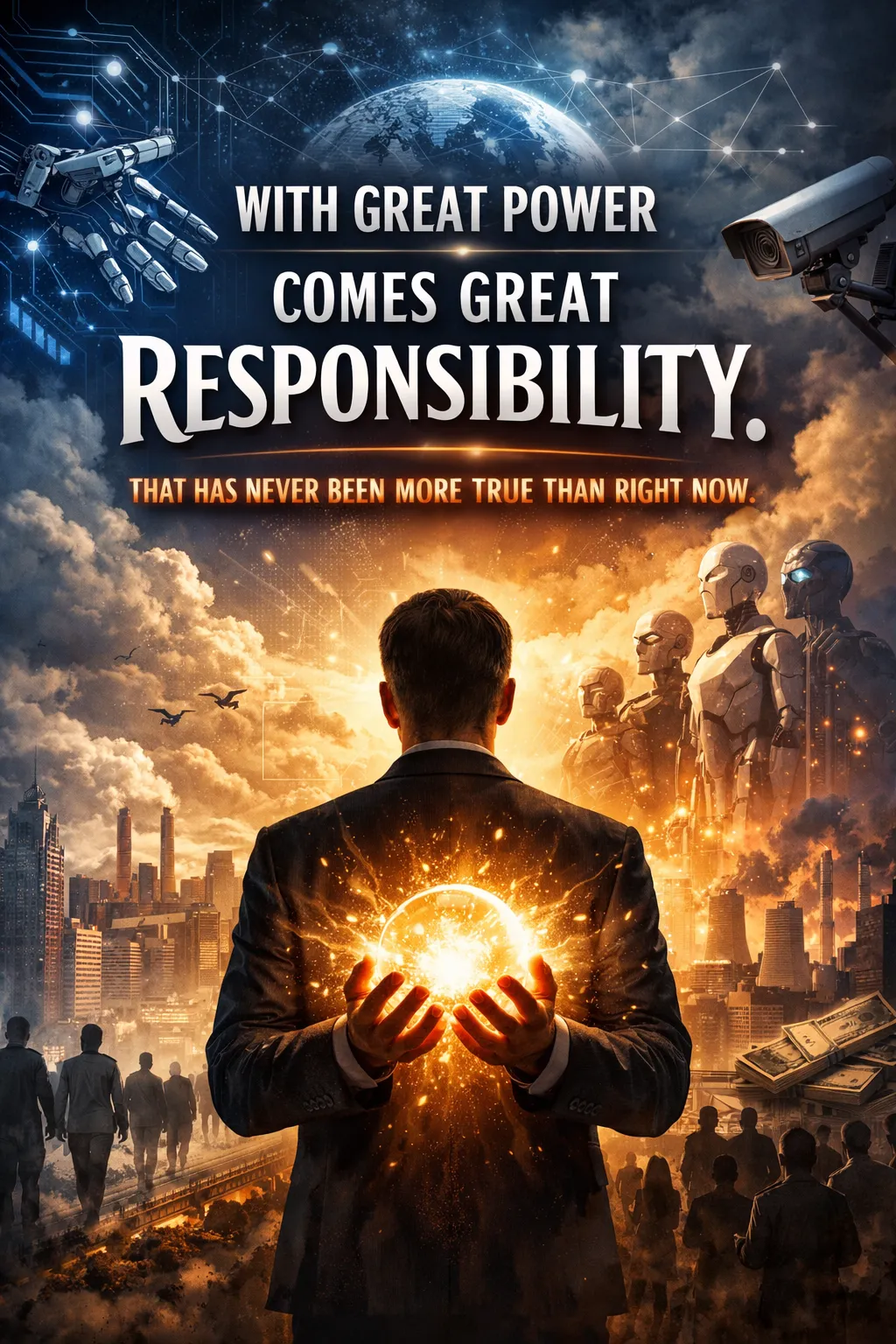
With great power comes great responsibility. That has never been more true than right now.
AI will not stop. But we can choose how to harness it. The question isn't whether AI will deliver a personalized experience. It already is. The question is whether we are being intentional enough to make sure it's the one we actually want.
#ArtificialIntelligence #FutureOfWork #Leadership #AI #Innovation #Technology #DigitalTransformation