How To Tell if Your Company Is Ready for AI
Key Takeaways
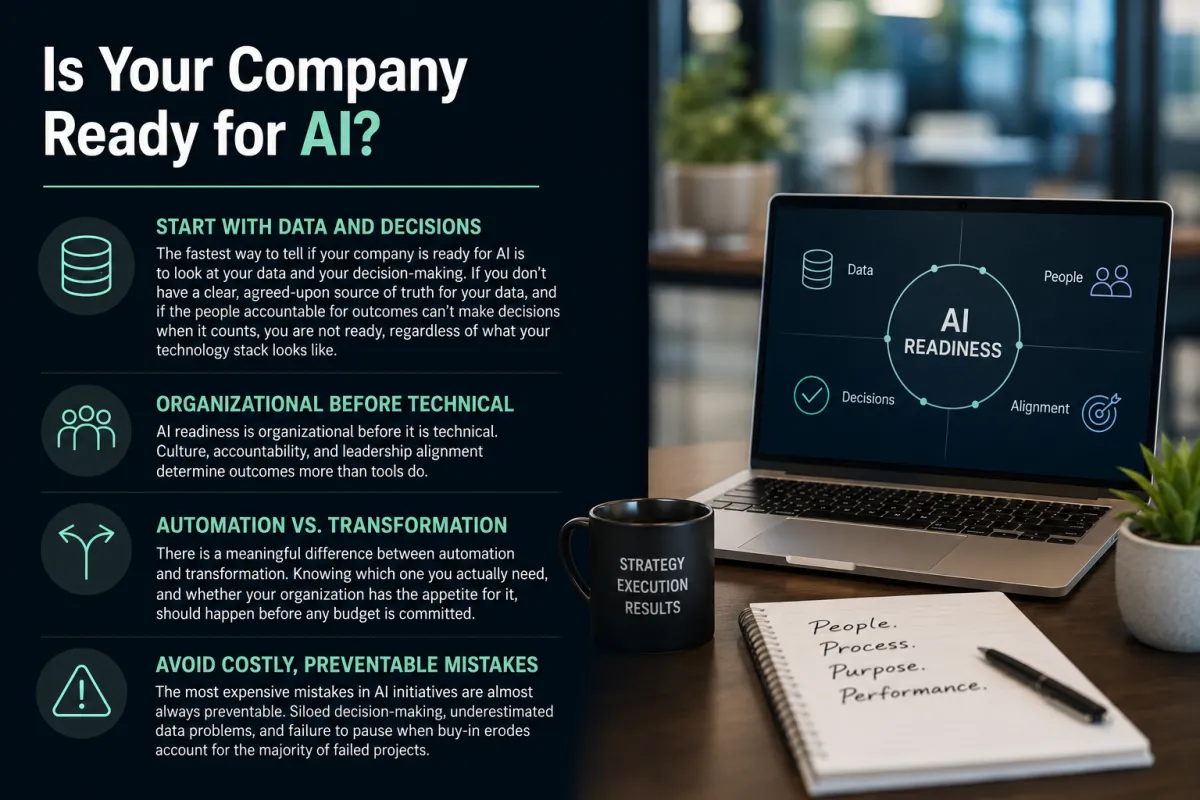
The fastest way to tell if your company is ready for AI is to look at your data and your decision-making. If you don't have a clear, agreed-upon source of truth for your data, and if the people accountable for outcomes can't make decisions when it counts, you are not ready, regardless of what your technology stack looks like.
AI readiness is organizational before it is technical. Culture, accountability, and leadership alignment determine outcomes more than tools do.
There is a meaningful difference between automation and transformation. Knowing which one you actually need, and whether your organization has the appetite for it, should happen before any budget is committed.
The most expensive mistakes in AI initiatives are almost always preventable. Siloed decision-making, underestimated data problems, and failure to pause when buy-in erodes account for the majority of failed projects.
Every week, another executive announces an AI initiative. And every quarter, another survey surfaces showing that the majority of enterprise AI projects fail to reach production or deliver meaningful ROI. According to McKinsey, fewer than 25% of organizations capture significant value from AI.
The gap between ambition and outcome is a readiness problem. Organizations launch AI initiatives before they have the data foundations, leadership alignment, or organizational readiness to make those projects succeed. Then they wonder why the results don't match the pitch deck.
This article gives business and technology leaders a practical AI readiness framework for evaluating where they actually stand before committing budget, people, and credibility to an initiative that the organization is not yet equipped to support.
Start With Leadership, Not Technology
The first signal of AI readiness has nothing to do with your tech stack. It’s whether the right leaders are in the room, and whether they can make decisions.
One of the clearest early warning signs that an AI project is heading toward failure is a breakdown in decision-making.
Look at the people who are listed on your project RACI as accountable for outcomes. When a decision needs to be made, can they make it? If the answer is no, that is a leadership problem, and it will follow the project everywhere.
Executive AI strategy requires more than sponsorship in name. It requires leaders who are present, aligned, and empowered to act. Before your organization commits to a major AI investment, take an honest read of who owns the outcome end to end, and what happens when that ownership is tested.
We created a Diagnostic Survey to do just that. It’s free, it’s comprehensive, and it will show you where you’re ready to transform (and where you aren’t).
Audit Your Data. Then Audit It Again.
Data readiness for AI is the single most common blocker in enterprise AI projects, and it is consistently underestimated.
Many organizations confuse having a lot of data with having AI-ready data. Volume without quality, structure, and accessibility is a liability. Data silos between departments, inconsistent definitions, and fragmented systems mean that whatever you build on top of that foundation will reflect those weaknesses back to you, usually at the worst possible moment.
And importantly, the initial data audit is almost never thorough enough. In our experience working with enterprise clients, when you start pulling on the threads, the problems are roughly double what the first pass surfaced. An infrastructure gap discovered six months into a project is significantly more costly than one identified before development begins.
Before any AI initiative moves forward, your organization needs a clear, agreed-upon source of truth. You need to know where your data lives, who owns it, how clean it is, and whether it can actually support the use cases you are planning to build.
Data quality for AI is not a technical checkbox. It is the foundation everything else depends on.
Automation or Transformation: Know Which One You Are Actually Doing
One of the most expensive mistakes in AI strategy is confusing automation with transformation. They are not the same thing, and they require completely different approaches.
Automation improves an existing process. It makes something faster, cheaper, or more consistent. The process itself stays intact. The people stay in their lanes. You are optimizing what already exists.
AI transformation changes the process entirely. The output may look the same, but how you get there is fundamentally different. And that means the people have to change, not just the systems they are using. New workflows, new ownership, new ways of working.
If you treat a transformation initiative like an automation project, you will end up with new tools running on old habits, which is almost always a very expensive disappointment. Knowing which path you are on, and being honest about it, should happen before a dollar is spent.
Assess Your Organization's Appetite for Change
When you’ve taken a look at the problem and thoroughly audited your data, it’s time for the hard part: the culture.
AI change management is one of the most underestimated dimensions of any AI initiative. According to Deloitte's State of AI in the Enterprise report, 42% of organizations cite employee resistance as a top challenge in AI adoption. An organization with modest technology but a strong learning culture will outperform an organization with cutting-edge tools and cultural resistance every time.
Before you scope an initiative, ask honestly: how much change is already happening in this organization? How resistant are people to working differently? Who owns adoption, and what does accountability for that actually look like in practice? These are not soft questions. They are the questions that determine whether your AI maturity model ever moves past the pilot stage.
The Questions to Ask Before You Spend on AI
Before any major AI investment, every executive should be asking:
Once this is up and running, how does our world change?
How does our staff change?
Who owns this process going forward?
Who owns adoption?
Defining what we call the “Day-Two” operational picture is one of the most valuable things a leadership team can do, and one of the least commonly done.
Your AI readiness checklist is only useful if it is honest. The organizations that capture real value from AI are the ones willing to ask hard questions before they start spending, not after.
Putting it all together
AI readiness is organizational before it is technical. The companies that succeed with AI are not necessarily the ones with the most sophisticated tools.
You want to be able to say you’ve assessed your foundations honestly, closed the gaps that mattered, and built with a clear picture of the outcome you were working toward.
If you are not sure where your organization stands, you need to get sure, and fast.
That is exactly where our AI Diagnostic Survey comes in. Take 8 minutes, and get a real look into where your organization is heading.
FAQ
What is an AI readiness assessment?
An AI readiness assessment is a structured evaluation of whether your organization has the foundations in place, including data quality, leadership alignment, process clarity, and cultural appetite, to successfully adopt and scale AI. It is designed to surface gaps before they become expensive problems, not after.
How long does it take to know if a company is ready for AI?
A solid initial read can be developed in a matter of weeks. The more important question is whether your organization is willing to look honestly at what the assessment surfaces. Many organizations have the information they need to know they are not ready. They just have not asked the question in a structured way yet.
What is the most common reason AI projects fail?
In our experience, it comes down to three things: siloed decision-making between IT and the business, data problems that were underestimated or ignored, and a lack of clear accountability for outcomes. The technology is rarely the primary culprit.
Do we need to be fully ready before starting an AI initiative?
Not necessarily, but you need to be honest about where your gaps are before you start spending. The organizations that get into trouble are the ones that launch without assessing readiness and discover their foundation is not solid six months and six figures in. A readiness assessment does not slow you down. It points you toward the fastest path to real results.