Why Isn’t My AI Investment Working? (It’s Not the Technology)
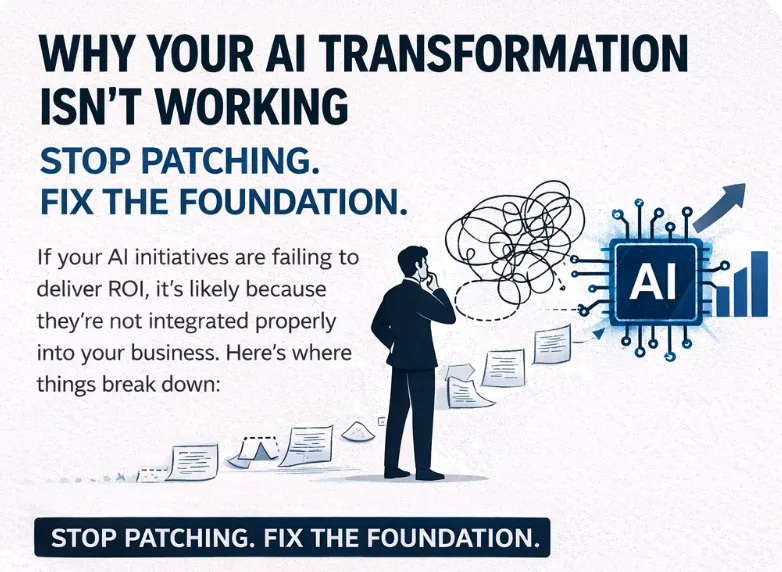
If your expensive, time-consuming AI transformation project isn’t working, it’s most likely because of your underlying structures and how your project is being deployed within the business. This guide walks you through where things break down, and how to start repairing them.
Key Takeaways
Your AI investment isn’t working because it’s not integrated into how your business actually runs. It’s being used as a tool on top of work, not embedded into processes, data flows, and systems where real outcomes are created.
AI without connection to real data and workflows creates activity, not impact. Manual steps, disconnected tools, and siloed use cases prevent any meaningful scale or efficiency gains.
Most organizations are measuring usage, not outcomes. Without clear metrics tied to business results, it’s impossible to know what’s working or where to invest further.
ROI comes from structure, not experimentation. A great consultant can help you repair this by tying AI to a defined problem, integrating it into end-to-end processes, and making sure there is clear accountability for results.
We’re experts in tech transformations with nearly 20 years of experience under our belts. To see if your team is ready for a full transformation, take the assessment here.
AI is now part of nearly every executive conversation.
Most organizations have invested. Many have launched pilots. Some have even rolled out tools across teams.
And yet, when you ask a simple question, the answer is often unclear:
What is the actual return on that investment?
This isn’t a question of effort. Teams are experimenting, building, and trying to move quickly.
The gap is that, for many organizations, the results don’t match the level of activity.
It’s easy to assume the issue is the technology itself. That the tools aren’t quite ready, or that the use cases are still emerging.
In reality, that’s not where the breakdown is happening.
The issue is the “how:” How is the tool being applied inside the business?
The Real Problem Isn’t AI
The current generation of AI tools is capable.
They can summarize, analyze, generate, and automate at a level that was not possible even a few years ago. In many cases, they can meaningfully reduce time spent on specific tasks.
So why isn’t that translating into consistent business impact?
Because most organizations are approaching AI as a tool to layer onto existing work, rather than as part of a system that needs to be designed.
When that happens, the result is predictable:
Teams use AI in isolated ways
Outputs don’t connect to downstream processes
Work still requires manual intervention
Results are inconsistent
At that point, AI becomes helpful, but not transformational.
Where AI Initiatives Break Down
When you look closely at where AI efforts stall, the patterns are consistent.
No Clear Problem to Solve
Many teams are encouraged to “find ways to use AI.”
That sounds productive, but it often leads to scattered experimentation.
Without a clearly defined problem, there is no anchor for the work. Teams create outputs, but those outputs are not tied to a measurable business need.
AI works best when it is applied to a specific constraint, not when it is treated as a general capability.
No Defined Outcomes
Even when there is a general direction, success is rarely defined upfront.
What metric should improve?
By how much?
Over what time frame?
Without that clarity, it becomes difficult to determine whether something is working.
The result is that AI efforts continue, but ROI remains unclear.
Disconnect from Real Data
This is one of the most common and most limiting issues.
In many organizations, the workflow still looks like this:
Download a file
Upload it into a prompt
Generate an output
Copy it into another system
It works, but only at a very small scale.
When AI is not connected directly to your systems and data sources, it becomes a manual layer on top of existing work.
The output may be faster, but the process is not fundamentally different.
Real value comes when AI is connected to the same data your business runs on, and when outputs can move seamlessly into the next step of a workflow.
No Process Behind the Tool
AI is often introduced into workflows that were already inconsistent.
Instead of redesigning the process, the tool is added on top.
That creates variability:
Different teams use it differently
Inputs are inconsistent
Outputs are not standardized
Without a defined process, it is difficult to scale results or build trust in them.
Fragmented Ownership
There is often a disconnect between business teams and technical teams.
Business users are experimenting with tools
IT is focused on infrastructure and security
No one owns the end-to-end solution
This leads to isolated efforts that never fully integrate into the organization.
Without clear ownership, even strong individual use cases struggle to scale.
The Illusion of Progress
From the outside, it can look like significant progress is being made.
There are new tools. New use cases. New internal discussions.
But inside the organization, a different pattern often emerges:
Many experiments are created
Few are consistently used
Even fewer are integrated into core workflows
Activity increases, but the way the business operates remains largely unchanged.
AI feels productive because it speeds up individual tasks.
But if those tasks are still disconnected from the broader system, the overall impact is limited.
This is where many organizations get stuck. They are doing more, but not moving differently.
What Actually Drives AI ROI
The organizations that are seeing measurable results are approaching this differently.
They are not starting with the tool. They are starting with structure.
A few principles consistently make the difference:
Start with the Business Problem
Define the specific constraint you are trying to solve. Tie it to revenue, cost, efficiency, or cycle time.
Define Measurable Outcomes
Establish a baseline and a clear target. Without this, it is difficult to evaluate success or make decisions about scaling.
Map the Process End-to-End
Understand how work currently flows, and where AI should be introduced. This includes identifying where human oversight is still required.
Connect to Real Data Sources
AI should be working with the same data your systems rely on. This eliminates manual steps and improves consistency.
Integrate into Workflows
Outputs should feed directly into the next step in the process. This is where efficiency gains begin to compound.
Establish Ownership and Governance
Someone needs to own the outcome, not just the tool. Clear ownership ensures accountability and ongoing improvement.
None of these steps are complex on their own.
But together, they shift AI from an isolated capability to part of how the business operates.
Important AI Decision for Leaders
Most organizations are still in an experimentation phase.
They are testing tools, exploring use cases, and building familiarity.
That phase has value. But it is not where ROI is realized.
The shift that needs to happen is from:
Isolated tools
Individual use cases
Manual workarounds
To:
Integrated systems
Defined processes
Clear accountability for outcomes
This is less about innovation, and more about operational discipline.
And that is where many AI initiatives either gain traction or stall.
AI Doesn’t Fail. Execution Does.
AI is already capable of delivering meaningful business value.
The gap is not in what the technology can do. It is in how organizations are structuring, connecting, and executing around it.
For leaders, this creates both a challenge and an opportunity.
The challenge is that simply investing in tools will not be enough.
The opportunity is that, with the right structure in place, many of the pieces are already there.
If your AI efforts feel active but not impactful, it is often a signal that something in the process, data, or ownership model is not aligned.
Taking the time to step back and address those foundations is where the return begins to show up.
The best place to begin is to assess your readiness: Are your current systems ready to take on a real transformation project?
The AI Readiness Assessment is the place to do that. 18 questions across four of the biggest areas of concern.