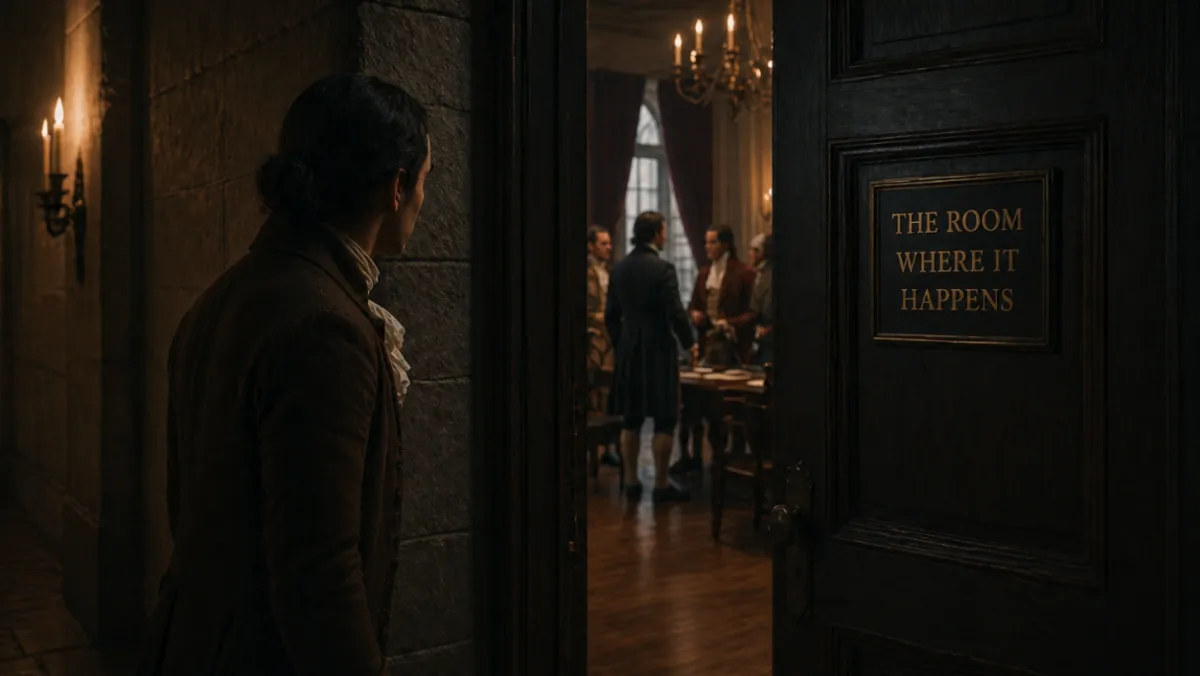
The Room Where It Happens — And What It Costs to Stay
If you've ever watched Hamilton, you know Aaron Burr. The one watching Hamilton, Jefferson, and Madison shape the future of a country while he's left wondering why nobody thought to include him. The song he gets for this feeling is one of the best in the show: The Room Where It Happens. Burr doesn't want power exactly — he wants proximity to it. He wants to be present when the real decisions get made. And what eats at him isn't just the exclusion. It's that he can't figure out the rules of how you get in.
That tension — the jealousy, the frustration, the suspicion that something important is happening without you — is not unique to Burr. Most people who've spent any time in a professional hierarchy know that feeling. The meetings before the meeting. The decisions that were already made by the time they hit the agenda. The sense that somewhere, in some room you haven't been invited into yet, the real conversation is happening.
But here's the question the song never quite gets to: what does being in the room actually cost you once you're there?
Early in my career, my sister worked on the executive floor of the same company where I was just starting out. I would go up to see her and find myself watching. How the leaders moved through the space. How they talked to each other. How they navigated complexity with what looked like complete ease. I was in my early twenties. It was intimidating. But more than anything, it made me curious. These people seemed to possess something — knowledge, understanding, a kind of wisdom — that I didn't yet have. The word I clung to was yet. I believed, even then, that it was attainable.
That hallway outside the executive floor was the first time I understood that there was a room where the real things happened. And I wanted to be in it.
What I didn't understand then — what took years to learn — is that getting into the room is only half the question. The harder half is this: what kind of person are you once you get there?
The slow education
The path into the room is not a straight line. Mine was built gradually, through mentors who taught me things nobody puts in a job description. One taught me how to hold myself in a meeting — when to speak and when to stay quiet, when to give details and when to give a summary. Others taught me that the seniority of the people in the room often determined how formal things would be, and more importantly, who the senior leader actually wanted to hear from — and who they did not.
You start to learn the politics. You see how people adjust when someone more senior walks in. You file all of it away. You get better at reading rooms. And then one day you realize something uncomfortable: all that learning has been shaping you. The mentors were not just teaching you skills. They were teaching you a version of yourself optimized for the room.
When you are in a room with people who have big titles, you feel like you are not the same as them. You feel like you need to earn it.
And so you earn it. You build knowledge, accumulate experience, become someone people count on. The imposter feeling doesn't go away — it gets louder the higher you climb, because the rooms get more consequential — but you keep showing up anyway.
The question nobody asks on the way up
Here is what I wish someone had asked me earlier: are you trying to get into the room to change it — or are you trying to get in so you can be seen?
Those are not the same thing. And most of us, if we are honest, have been motivated by both at different points. There is nothing wrong with wanting to be seen. Visibility matters. Being at the table matters. But when visibility becomes the primary goal, something shifts. You stop asking what you need to say and start asking what will land well. You stop thinking about what the decision needs and start thinking about what the senior leader wants to hear.
I have been in rooms where I felt genuinely free to challenge the thinking, to push back, to offer a different view. And I have been in rooms where I edited myself — not because I didn't know enough, but because I read the room and calculated that speaking freely carried a risk I wasn't sure I wanted to take. What I didn't see in those moments was the cost. Trust erodes in small amounts. The bill was running. I just couldn't see it yet.
Being in the room is not the same as leading in the room
A seat at the table that you protect by only saying what is safe to say is not leadership. It is proximity. It looks like influence from the outside, but inside the room, everyone can feel the difference between the person who is there to contribute and the person who is there to survive.
The most dangerous dynamic in any leadership team is when everyone in the room is optimizing for staying in it. When that happens, the room stops being a place where truth is spoken and starts being a place where the most senior person's existing view gets reflected back at them. Bad decisions don't get challenged. Problems that need to be named stay unnamed. The organization pays for every unspoken truth.
Not being in the room can be frustrating. But being in the room and saying nothing real — that might be worse.
The room we build for others
When I moved into leadership, I thought a lot about what kind of room I wanted to create. I had spent years learning when to speak and when to be silent, how to frame things for the right audience, how to read the temperature before offering a view. And what I wanted most for the people who worked with me was the opposite of all that. I wanted them to be able to just say it. Unpolished. Unfiltered. To find the words in real time, even when the right words hadn't arrived yet.
I wanted to build the room I never quite had.
What I also learned is that nobody tells you how to do this. The unwritten rules get passed down unevenly — often only to the people leaders already see themselves in. Everyone else figures it out through trial and error. We need leaders who will explicitly coach their people through the politics, who will name the dynamics out loud, who will say: here is what is happening in this room, here is how to navigate it, and here is how to hold onto yourself while you do.
Was it worth it?
Someone asked me recently whether it was all worth it — the years of earning, the imposter feeling, the unspoken things, the trust I lost without seeing it go. Was getting into the room actually worth the price?
My honest answer: sometimes yes. And sometimes I think it was more about being seen than being bold.
That admission used to embarrass me. Now I think it's the most important thing I could say to anyone earlier in their career. The room is real. The access matters. The ability to influence decisions that affect real people — that is worth chasing.
But if you spend your whole career getting into the room and then go silent to protect your seat in it, you have answered the wrong question. The room is not the destination. It is the place where you finally get to find out what you are actually made of.
The question was never can I get in?