What is AI Governance? And Why Is it a Must-Have In your Strategy? Blog Post
What is AI Governance? And Why Is it a Must-Have In your Strategy?
Key Takeaways
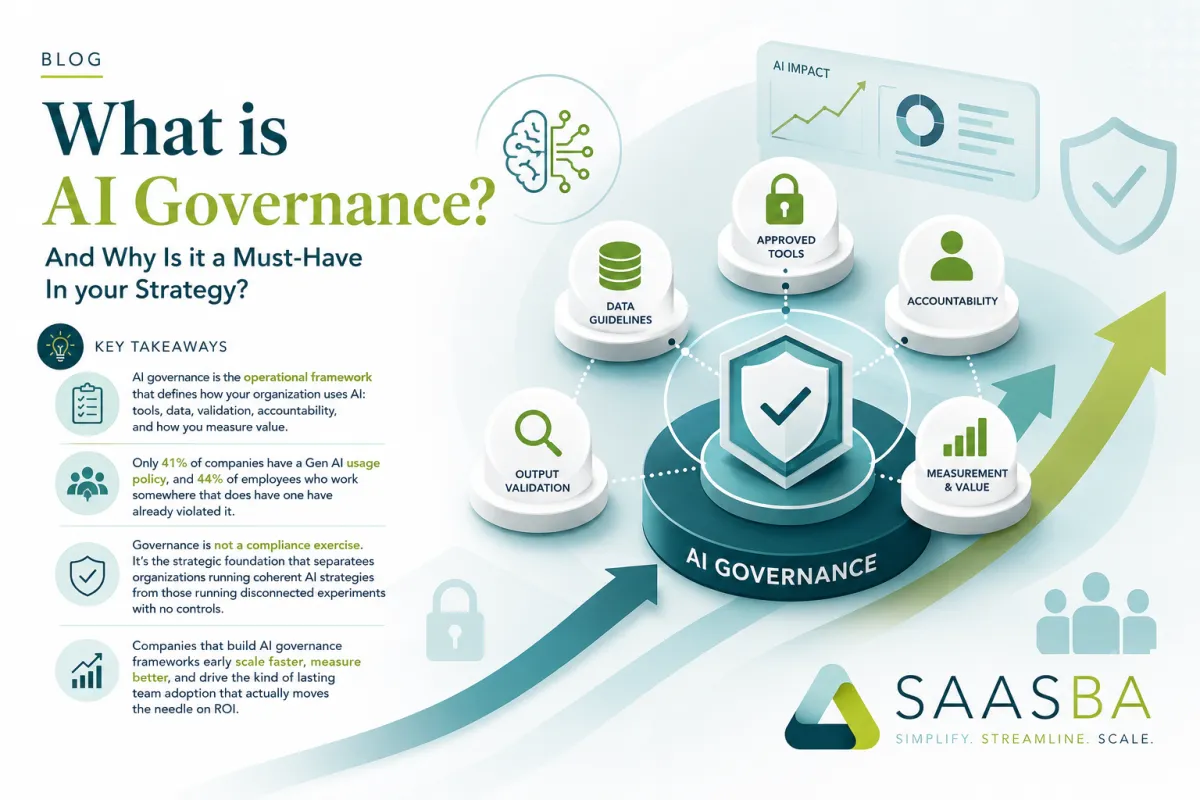
AI governance is the operational framework that defines how your organization uses AI: which tools are approved, who can use them, how outputs are validated, who is accountable when something goes wrong, and how you measure whether AI is actually delivering business value.
Only 41% of companies have a Gen AI usage policy, and 44% of employees who work somewhere that does have one have already violated it, according to Elementum AI's latest research.
Governance is not a compliance exercise. It's the strategic foundation that separates organizations running coherent AI strategies from those running disconnected experiments with no controls.
Companies that build AI governance frameworks early scale faster, measure better, and drive the kind of lasting team adoption that actually moves the needle on ROI.
There's a statistic from Elementum AI's recent report that every business leader should sit with.
Only 41% of companies have a Gen AI usage policy. And of the employees who work somewhere that does have one, 44% have already violated it.
Read that in the context of what else is happening right now: AI-powered cyberattacks are on the rise, targeting organizations at every level, including government institutions. The same technology your teams are integrating into their daily workflows is being weaponized against organizations that moved fast without thinking carefully about what they were doing.
This is not a reason to slow down your AI transformation. It is a reason to be thoughtful about how you lead it.
The Governance Gap
When we talk with business leaders about AI strategy, governance rarely comes up in the first conversation. It's treated as something to address later: after the tools are in, after the pilots are running, after the team has had a chance to "figure it out."
That sequencing is exactly backwards.
Governance isn't the bureaucratic layer you add after the fact. It's the strategic foundation that makes everything else work. It determines how your organization uses AI, how you measure whether it's working, who is accountable when something goes wrong, and what you do next. Without it, you're not running an AI strategy. You're running an experiment with no controls.
The companies we work with that see real, measurable AI ROI, the ones who move from pilot purgatory to scaled outcomes, share one thing in common: they built the foundation before they built the solution. That foundation always includes governance.
What Governance Means
Let's be clear about what we're not talking about. Governance is not compliance. It's not a legal checkbox or an IT policy buried in a handbook nobody reads. Those things matter, but they're not the same thing.
An AI governance framework is a practical operating structure for how your organization works with AI. It answers questions like:
Which AI tools are approved for use, and by whom? What data can be shared with those tools, and what can't? How do we validate AI-generated outputs before they're used in decisions or customer-facing work? Who owns the outcomes when AI is part of the process? How do we measure whether AI is actually delivering business value?
These aren't complicated questions. But most organizations haven't answered them – not because they don't care, but because the pressure to move quickly has pushed governance to the bottom of the list. The Elementum data tells us exactly where that leads.
The Cost of Moving Without a Framework
Consider what's happening inside organizations right now. Teams are signing contracts for AI platforms under competitive pressure. Individual contributors are finding tools on their own and integrating them into workflows without IT awareness. Leaders are making decisions based on AI-generated analysis without validation protocols in place.
In many of these organizations, the AI rollout looks successful on the surface. People are using the tools. Productivity feels like it's up. But without an AI governance framework, there's no way to know what's actually working, what's creating risk, or what the true cost of the investment is.
We've seen organizations run hundreds of custom AI automations with only a fraction delivering measurable outcomes. We've seen companies absorb significant token costs with no clear line of sight to ROI. We've seen AI outputs used in client-facing work that were never validated because nobody had established a process for what "good enough" looks like.
This is what the governance gap looks like in practice. It's not a dramatic failure. It's a slow accumulation of risk and wasted spend that becomes very difficult to unwind.
Governance and Transformation: Two Sides of the Same Equation
At SaaSBA, our AI transformation consulting work is built on a foundation-first approach. Before we help a company scale AI across their organization, we help them understand what they're actually building on. That means process redesign, change management, team adoption strategy, and measurable outcome frameworks, not just tool implementation.
Governance sits at the center of that work. Not as a separate workstream, but as the connective tissue that holds an AI business transformation together. It's what allows you to move quickly without moving recklessly. It's what turns AI adoption from a series of disconnected experiments into a coherent strategy with accountability and results.
For some organizations, governance becomes its own dedicated engagement: a structured process for building the policies, frameworks, and accountability structures that an enterprise AI rollout requires. For others, it's woven into a broader AI strategy consulting engagement from day one.
The right approach depends on where you are in your AI journey.
What's consistent across every engagement is this: the organizations that invest in governance early spend less time course-correcting later. They scale faster, they measure better, and they build the kind of organizational confidence in AI that drives lasting adoption.
Where to Start
If your organization is in the middle of an AI rollout (or planning one) the governance conversation doesn't have to be overwhelming. It starts with a few honest questions.
Do we know how our teams are using AI right now? Do we have a clear policy, and does our team actually know what it says? Do we have a process for validating AI outputs before they influence decisions? Do we know what we're spending on AI, and what we're getting for it?
If the answer to any of those is "not really," that's where to begin.
The window to get ahead of this is narrowing. The organizations building AI governance frameworks now are the ones that will scale AI effectively over the next two to three years. The ones waiting until something goes wrong will spend that time rebuilding trust (internally and externally) instead.
This is AI transformation done right. Not just new tools, but a new way of operating, with the structure and accountability to make it last.
If you'd like to talk about what an AI governance framework could look like for your organization, we'd welcome the conversation.