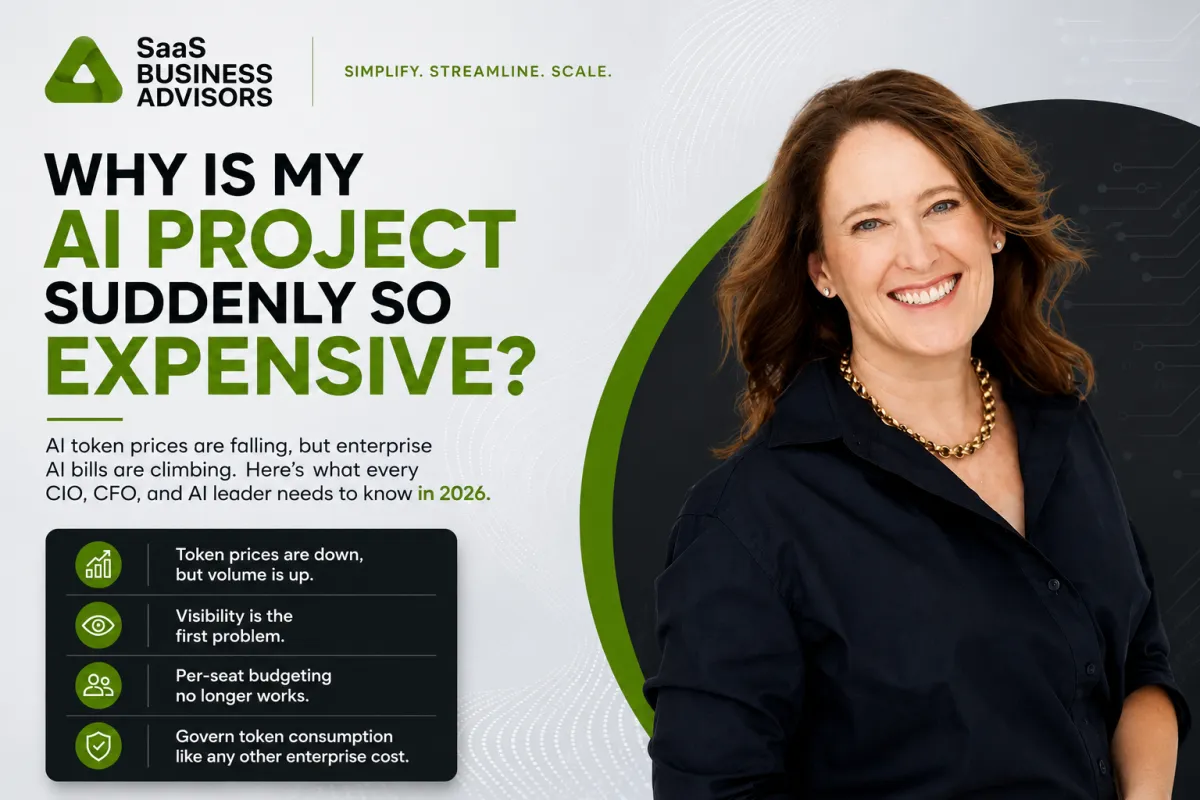
Why Is My AI Project Suddenly So Expensive?
You approved the AI budget and rolled out the tools. Adoption numbers looked great.
And then the invoice arrived…far over what you’d expected.
If you are a CIO, CFO, or AI transformation leader staring at an AI bill that bears no resemblance to what you planned for, you are not alone, and you are not doing anything wrong. What you are experiencing is the first big shift in the token economy, and understanding “tokenomics” is quickly becoming one of the most important things an enterprise leader can do in 2026.
Key Takeaways
The token economy is simple: AI token prices are falling, but the volume of tokens enterprises are consuming is growing far faster. And the bill reflects volume, not price.
Visibility is the first problem. Most organizations have no idea which teams, tools, or use cases are driving their token spend.
Per-seat SaaS budgeting does not apply here. Cost is driven by how intensively AI is used, not how many people have access to it.
Token consumption belongs in your governance framework now — not after the next invoice surprises your CFO.
What Is a Token, and Why Does It Cost Money?
Every interaction with a large language model, whether it is a simple question, a document summary, or a multi-step AI agent completing a workflow, is processed in units called tokens. Tokens are roughly equivalent to word fragments. A thousand tokens is approximately 750 words. Every time your team uses an AI tool, tokens are being consumed. And every token has a cost.
Now, how many tokens does your particular query use up? Right now, there’s no real way to know. Wha we do know is that the blended cost of AI dropped 67% year over year, falling from $18.40 to $6.07 per million tokens between Q1 2025 and Q1 2026. Token prices are falling. So why are enterprise AI bills going up?
The short answer is: Because volume is growing faster than prices are falling. The average enterprise AI budget grew from $1.2 million per year in 2024 to $7 million in 2026, and the FinOps Foundation's 2026 State of FinOps report found that 73% of enterprises reported their AI costs exceeded original projections.
The unit price is lower. The total bill is higher. The gap between them is the newly-emerging token economy, and most enterprise budgets were not built to account for it.
The Agentic Shift in AI
The reason token consumption has exploded is not that your teams are wasting AI tools. It is that the nature of AI work has fundamentally changed.
In 2024, a typical AI interaction was simple: a user submits a prompt, the model responds. That exchange consumed a relatively modest number of tokens. In 2026, enterprises are deploying agentic AI workflows, meaning AI systems that decompose a task, select tools, call sub-agents, validate outputs, and retry on failure, all without step-by-step human instruction.
Research from Microsoft and Stanford's Digital Economy Lab found that agentic tasks consume roughly 1,000 times more tokens than standard chat interactions. Cut the price per token by 75%, deploy a system that consumes 250 times more tokens per task, and the math is unambiguous. You pay more.
A coding agent fixing a bug might burn 200,000 tokens reading the codebase, exploring failure modes, and iterating on a patch. A research agent answering one question might consume a million tokens across web reads and synthesis steps.
This is not a bug. It is how these systems work. But it is also something that almost no enterprise AI budget, set in 2024 or early 2025, was designed to absorb.
How Uber Experienced the Token Problem
This is not a theoretical problem. Uber gave 5,000 engineers access to AI coding tools in December 2025. By April, the company had burned through its entire annual AI budget in just four months, after incentivizing employees to adopt the technology through an internal leaderboard ranking teams by total AI tool usage.
Uber COO Andrew Macdonald said on the Rapid Response podcast that it was hard to draw a connection between the company's rising use of AI tools and innovations meant to serve consumers. Higher adoption, and higher spend, but no clear line to business outcomes.
Uber is not an outlier. It is a preview. At least three more public AI budget walk-backs are expected before Q3 2026, as adoption metrics were set as the success criterion at most companies in 2025, and that metric is now blowing past the budget.
Why Your Original Budget Is Now Structurally Obsolete
Most enterprise AI budgets were built on a per-seat model, the same logic that governed SaaS licensing for the past two decades. You count users, multiply by a license fee, and you have your number.
The token economy does not work that way. Cost is not a function of how many people have access. It is a function of how intensively those people use the tools, and how complex the tasks those tools are performing. An engineer who runs a simple prompt consumes a fraction of the tokens that an engineer running an agentic debugging workflow does. Both have the same seat license.
Anthropic's annualized revenue reportedly grew from $9 billion at the end of 2025 to over $44 billion by May 2026, almost entirely through enterprise token consumption. The vendors are benefiting from the volume explosion. Most enterprise finance teams have not yet built the models to manage it.
What Enterprise Leaders Should Do Right Now
Understanding the token economy is not just a finance exercise. It is a governance question.
If it’s feeling overwhelming, I recommend you start with a few simple steps:
First, audit your current token consumption by team, tool, and use case. You cannot manage what you cannot see. Most organizations running AI at scale have no visibility into where their token spend is actually going.
Second, distinguish between your high-value and low-value token consumption. Not all AI usage is equal. An agentic workflow that replaces a five-hour manual process is generating real ROI. A team of engineers running exploratory prompts all day because the tools are available and feel free is generating a very large invoice.
Third, build token consumption into your AI governance framework alongside your roadmap and your data strategy. The organizations getting enterprise AI ROI right are the ones treating token costs the same way they treat cloud infrastructure costs: with visibility, accountability, and guardrails.
The token economy is not going away. Goldman Sachs has projected 24x growth in token consumption by 2030. The enterprises that understand this now, and build governance structures around it, will be the ones that can actually afford to scale.