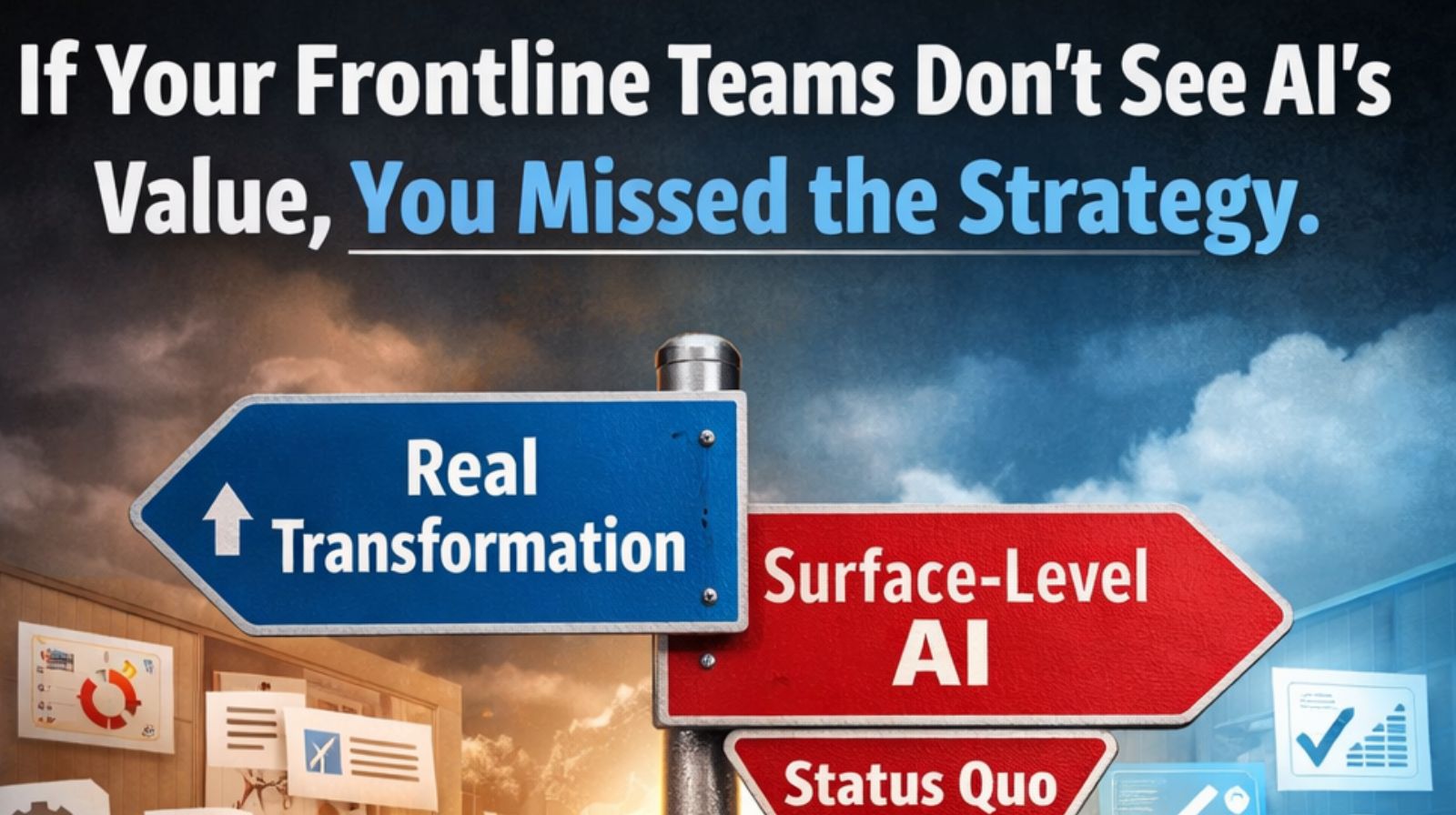
If Your Frontline Teams Don’t See AI’s Value, You Missed the Strategy.
I’m going to say something that might sting a little.
If your sales reps, customer success managers, or service teams are not feeling a material difference from AI in their day-to-day work, then you probably don’t have an AI strategy. You certainly don’t have a good one.
Right now, nearly every company claims they’re “doing AI.” Most of them cannot point to measurable bottom-line impact. And the reason is simple: copilots are easy to deploy, but real workflow transformation requires operating model discipline that most organizations have avoided for years.
Your frontline teams know the difference. Do you?
AI That Looks Impressive (But Changes Nothing)
Here’s what usually happens.
A pilot launches. The vendor demo is polished. A steering committee meets. A dashboard gets built. Updates go upstairs, and the narrative sounds clean and controlled.
Meanwhile, the rep is still reconciling bad account data, toggling between three systems, chasing down approvals, and re-entering information because the workflow itself hasn’t changed. Now there’s just an AI-generated summary sitting on top of the same broken process.
This is not an AI transformation. It’s a surface-level enhancement glued on top of structural inefficiency.
If your AI doesn’t remove friction from real workflows (fewer clicks, fewer handoffs, fewer manual corrections) it’s merely cosmetic. And it is probably making your team more frustrated, not less.
If They Don’t Feel It, It Doesn’t Exist – 03/05/26
Here’s the simplest test I use:
Ask your frontline teams, “What’s meaningfully different for you since we rolled out AI?”
If the answer sounds like:
“It’s kind of helpful.”
“It saves a little time.”
“We still mostly do it the old way.”
Then the strategy never made it past the executive layer.
Real strategy shows up in throughput. It shows up in cycle time, in cleaner data and faster decisions and fewer internal escalations, and in measurable operational lift.
If the people doing the work are not experiencing speed, clarity, and reduced friction, the initiative is stalled, regardless of what the slide deck says.
This Is an Operating Model Issue
My biggest point here: AI is not a feature set you bolt onto an existing environment and hope it behaves differently than everything else you’ve installed over the past decade.
It is an operating model shift.
That means you redesign workflows before automating them. You define ownership before scaling data. You establish governance before expanding use cases. You align incentives before declaring success.
Most organizations reverse that order. They start with the technology because it feels productive, and only later realize that adoption, accountability, and data discipline were never clearly defined.
And then they wonder why ROI doesn’t show up.
The Hard Question
If your AI initiative disappeared tomorrow, would your frontline teams fight to get it back?
If the honest answer is no, then you’re still experimenting, not transforming.
And experimentation alone does not produce sustained ROI.
Where the Disconnect Actually Lives
When we step into these environments, we don’t start by evaluating the tool. We start by evaluating the mechanics around it.
Who owns the data feeding the model?
What workflow is this supposed to eliminate or materially accelerate?
Which KPI moves if this works?
Who is accountable after go-live?
What breaks when this scales?
If those answers are vague, your AI strategy is vague. And vagueness at scale turns into very expensive disappointment.
If your teams aren’t seeing real workflow impact, you don’t have strategy alignment.
Before you launch another pilot or expand another license agreement, get clear on where the disconnect actually is.
Take the AI Readiness Assessment. It will show you whether your issue is data, governance, ownership, workflow design, or executive alignment before you invest further.
Start here: https://ai-assessment.saasba.com/