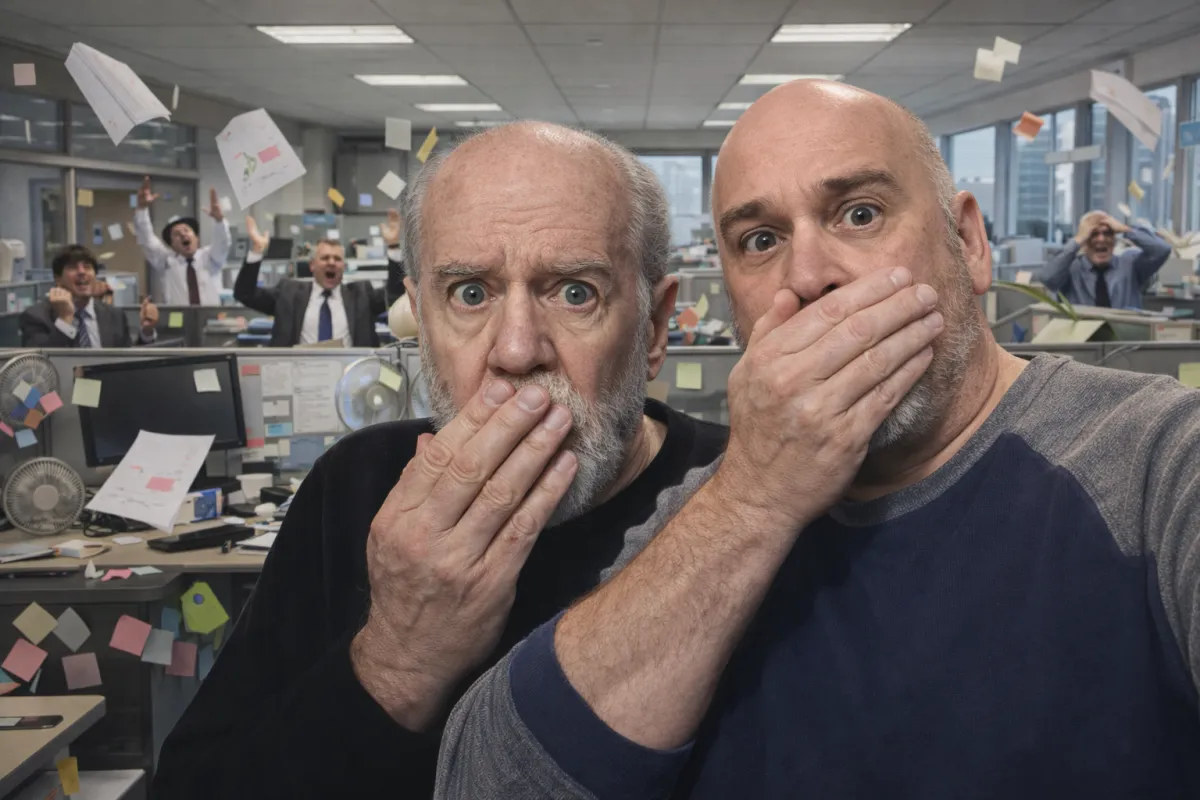
George Carlin Had Seven Dirty Words. Executives Have Seven Dirty Words Too.
When I was a kid, one of my favorite comedians was George Carlin. I remember being in 7th grade and going to my friend's house and listening to his albums (Yes, I am that old). At the time, I'm not sure I fully understood the meaning behind everything he said, but I remember listening and knowing he was saying more than just jokes. He was making commentary on everyday life, observations about the future — which turned out to be spot-on — and connecting with audiences, using humor. What I loved about him was he used words and language to bridge a gap in society that allowed him to engage with audiences whether they agreed or disagreed.
One of his best segments was the seven dirty words you can't say. I am not here to repeat or update those words for the 21st century, but I thought I would use the concept and reshape it for the AI generation. The genius of what George Carlin understood was that language had the power to shine a light back on individuals and show them, at times, the hypocrisy and silliness of the words — but also how those words are used.
In the world of digital and AI transformation, executives have perfected leveraging similar language. There are seven words — you've heard all of them, you've probably said them — that create the impression of bold action while allowing organizations to avoid the uncomfortable conversations that real transformation actually requires.
These aren't bad words. That's what makes them so effective. They sound like progress. They sound like leadership. They give everyone in the room something to nod along to.
And that is exactly the problem.
The seven words below are from the first set. Learn to recognize them — in your strategy documents, in your all-hands presentations, in your own sentences — because wherever they appear, there is almost always a harder word hiding just behind them.
The Seven Words
1. Digital Transformation
The word behind it: Irrelevance.
There are some words that people just react to — like governance, circle-back, etc. — but no phrase has done more work for less result in the last decade. Transformation is the perfect organizational comfort blanket — broad enough to mean anything, ambitious enough to sound serious, and vague enough that nobody can be held accountable when it stalls.
When an organization says it is undertaking a Transformation, it normally means: we know it is time to change, reorganize, and take a new approach. What it is usually saying underneath that is: we know things need to change, we are not yet sure what specifically, and we would like to feel better about that uncertainty for a while longer. The word transformation implies a destination. Most organizations using this phrase haven't defined one.
The real question hiding behind it: transform into what, by when, and who is accountable if we don't? If it doesn't happen quickly, will we be irrelevant?
2. AI-Enabled
The word behind it: Competitive Blindspot.
AI is everywhere and new jargon comes with new technology. We are now all "AI-Enabled" — a phrase that sounds like capability and often signals the opposite. Slapping AI-Enabled onto a product, a process, or a strategy document requires no proof of value, no measurement framework, and no real commitment to the work that makes AI actually function.
The organizations that are genuinely ahead in AI are not the ones describing themselves as AI-Enabled. They are the ones quietly redesigning workflows, cleaning data, and measuring outcomes — not touting tool proliferation and shiny new capabilities.
The real question hiding behind it: what specifically does AI do here, and how do we know it's working?
3. Innovation
The word behind it: We don't have a plan.
Many would agree that driving innovation is how you stay ahead of your competition and drive customer value. Innovation is what organizations say when they want to signal ambition without committing to anything specific. It is the word that appears in mission statements, keynote talks, and annual reports with perfect consistency — and virtually no operational definition.
Real innovation is uncomfortable. It requires hard conversations, real data-driven metrics, saying unpopular things in the meeting. It requires a budget for experiments that will fail. It requires executives willing to sponsor ideas that make the current business model look fragile and obsolete, but thinks 3-5 years into the future. Most organizations that talk about innovation the most practice it the least, because the word allows them to claim the identity without doing the work.
The real question hiding behind it: what did we actually build this year that didn't exist last year, and what did we stop doing to make room for it?
4. Agile
The word behind it: Legacy.
If I had a dollar for every time someone said we are being "Agile" I would be sitting on a beach somewhere. The intent behind being Agile is to move quicker, fail fast and try again. Hopefully learn how to get to the end result quicker and reduce the cost. We put a lot on that one word and ask it to do a lot of work for us. We expect that people are all on the same page, we are able to quickly extract, synthesize and develop prototypes and working systems that result in outcomes. In reality we mix waterfall with Agile and call it Agile.
The reality is organizations adopt the rituals of Agile — the sprints, the scrums, the retrospectives — while keeping the decision-making structures, the approval chains, and the budget cycles of organizations that have never heard of it. The result is the worst of both worlds: the overhead of a new process layered on top of the inertia of an old one.
The real question hiding behind it: are we actually able to make faster decisions, or have we just renamed our meetings?
5. Data-Driven
The word behind it: Customer Churn.
Data, data everywhere, but not an outcome to speak of! This is one of the most overused words and it gets worse every year! Being data-driven requires clean data, accessible data, shared data — and a culture where the data is actually allowed to challenge the decision that leadership was already planning to make. That last part is where most organizations quietly give up.
What most organizations have is data-available — which is entirely different. The data exists somewhere. It lives in silos. It requires a request and a wait and a spreadsheet that's already three weeks old by the time someone acts on it. In the AI era, that gap between data-available and data-driven is exactly where value is being lost — and where competitors who closed the gap are pulling ahead.
The real question hiding behind it: can I see the truth about my organization and have a substantive conversation with my peers and agree — or are we just fighting over what the data means?
6. Disruption
The word behind it: Margin Erosion.
Over the course of human history we have seen real disruption; AI is the latest version and just like every other time, it takes time for people to adapt. The reason people disrupt is often because the incumbent has become lazy, complacent, and no longer solving the pain points. Now we find someone to do it quicker, cheaper, and drive efficiency. This cycle happens over and over again.
Here is the tell: when established organizations describe themselves as disruptive, they are almost always playing defense. Real disruptors don't call themselves disruptors. They call themselves inevitable. The company that uses disruption most frequently in its marketing materials is usually the one most worried about being disrupted — and hoping the language will obscure the anxiety.
The real question hiding behind it: where is our margin actually being threatened, and by whom?
7. Future-Ready
The word behind it: Board Accountability.
Future-Ready is the ultimate hedge. It sounds like a destination while committing to nothing. It has no timeline. It has no metric. It cannot be falsified. You cannot point to a moment and say "we are not Future-Ready" because the future hasn't arrived yet — which is precisely why the phrase is so popular with leadership teams that are not ready for it.
Boards are getting wise to this one. The questions coming out of governance conversations now are specific: what percentage of our workflows have AI integrated? What is our data readiness score? How fast can we stand up a new model? Future-Ready doesn't answer any of those questions. It just sounds like it might.
The real question hiding behind it: ready for what, specifically, and how would we know if we weren't?
The Words Behind the Words
Carlin's point wasn't that the forbidden words were good. It was that the gap between the acceptable word and the forbidden one was where the truth lived. The institution's discomfort with plain language was itself the data.
The same gap exists in every strategy document that says Transformation instead of "we are falling behind." In every all-hands that says Innovation instead of "we don't know what to build next." In every board deck that says Future-Ready instead of "we have no way to measure our own readiness."
There is an honesty and vulnerability missing in leadership that doesn't really allow employees to connect the dots. We use words that don't speak to the problem statement, but to a lofty vision that leverages a language that might help frame the problem, but not solve it.
The seven words in this piece are not the enemy. Used precisely, with accountability attached, any of them can describe something real. The problem is that they rarely are. They function instead as a language of motion — creating the feeling of forward progress while the organization stands still.
The Challenge
The next time one of these seven words appears in your organization — in a presentation, a strategy session, a planning document, a conversation — try replacing it with the harder word hiding behind it.
Say irrelevance instead of digital transformation. Say customer churn instead of data-driven. Say margin erosion instead of disruption. Say board accountability instead of future-ready.
Notice what happens in the room. Notice who gets uncomfortable. Notice what conversation suddenly becomes possible that wasn't possible a moment before.
That discomfort is not a problem. That discomfort is the work.
Carlin knew it. The executives who navigate this era successfully will know it too.
Stop saying the comfortable words. Start saying the true ones.