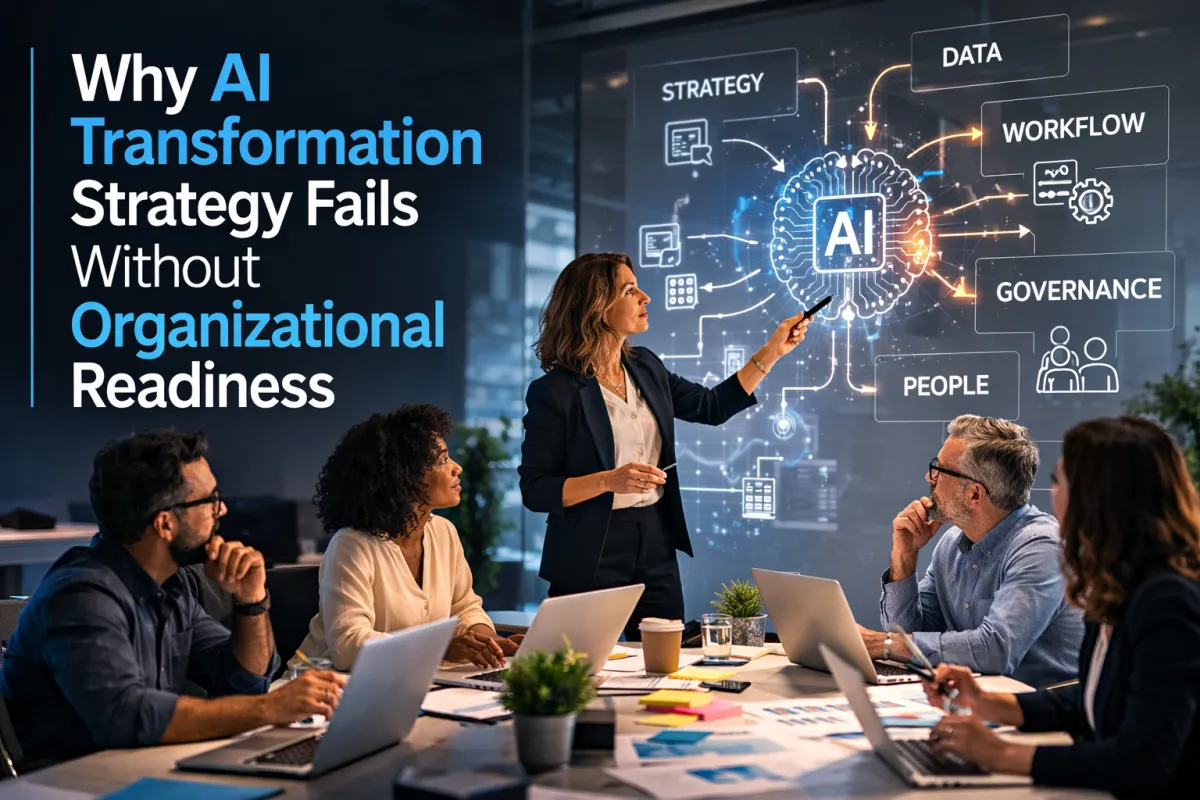
The Human Element Is the Multiplier:
Why AI Transformation Strategy Fails Without Organizational Readiness
Key Takeaways
1. AI transformation strategy requires organizational redesign, not just deployment.
Workflow, incentives, and governance must evolve alongside technology.
2. AI readiness is a leadership discipline.
Executive alignment and cross-functional accountability determine success.
3. Incentives drive AI adoption.
If performance metrics contradict automation goals, resistance will follow.
4. Governance determines AI ROI.
Clear reporting, ownership, and transparency prevent value erosion.
If you’re working through an AI transformation right now and feel like it’s getting lost in your team’s day-to-day responsibilities,
There is a persistent narrative circulating in boardrooms (and on LinkedIn, and just about everywhere else): “AI will replace people.”
It’s simple. Automation increases efficiency. Headcount drops. Margins rise.
But after advising - senior IT and revenue operations leaders through complex digital transformation programs, one truth is clear:
The companies winning with AI are not automating people out.
They are simply redesigning how people work.
AI is not the replacement engine.
It is the multiplier.
And the multiplier only works if the human architecture is strong.
AI Transformation Strategy vs. AI Experimentation: The Digital Transformation Inflection Point
Most organizations are still in AI experimentation mode. They launch pilots, deploy copilots, and test point solutions.
Then they wait for AI ROI.
But typically, this method of AI transformation does not give orgs the results they want.
Measurable AI ROI comes from doing four things differently:
Redesigning workflows
Realigning incentives
Rethinking executive reporting
Establishing digital transformation governance
These are not technical upgrades, but leadership decisions.
This is the Architecture Imperative: AI success depends on aligning people, process, and platform inside your AI operating model.
Workflow Redesign for AI Implementation: Modernizing the SaaS Operating Model
AI layered onto broken workflows simply accelerates inefficiency. If your revenue operations model is fragmented, AI will move inconsistent data faster.
If customer onboarding lacks clarity, AI will automate confusion.
So, pause for a moment and ask:
What should this workflow look like in an AI-enabled enterprise?
Which decisions require human judgment?
Where does automation remove friction without removing accountability?
Redesign before you deploy, and AI readiness will become operational reality.
Incentive Realignment and Change Management for AI Adoption
Many AI initiatives stall not because of the model, but because of incentives.
Leaders approve AI tools. Teams attend training. Pilots run successfully.
But performance metrics remain unchanged.
If compensation plans reward manual effort, automation will be resisted. If teams are measured on volume instead of outcomes, AI efficiency becomes a threat.
Human behavior always follows incentives. So, we need to incentivize using AI. That means adjusting how we measure success:
Compensation structures
KPI definitions
Accountability frameworks
Performance measurement models
AI adoption requires change management discipline, not just technical enablement.
Executive Reporting, AI Governance, and the CEO’s Role in Digital Transformation
There is a moment in every AI initiative when the board asks, “What are we getting for this investment?”
This is where executive clarity becomes decisive.
Leadership must articulate:
The business problem AI is solving
The measurable value being generated
Adoption progress across functions
Emerging risks to delivery
AI transformation cannot be delegated to IT alone.
It requires:
Executive alignment
Cross-functional governance
Structured reporting
Transparent performance tracking
This is the CEO Moment.
AI is not a technology program. It is an enterprise transformation program.
AI Readiness Assessment: Organizational Architecture Determines AI ROI
In our advisory work with midsize B2B SaaS companies, AI readiness consistently hinges on four pillars:
1. Strategy & Vision Alignment
Clear articulation of how AI supports long-term enterprise objectives.
2. Data & Infrastructure Governance
Trusted data, clear ownership, scalable architecture.
3. Talent & Skills Capability Mapping
Understanding current capability vs. future-state requirements.
4. Experimentation & Delivery Execution
Governance that moves pilots to scaled operational value.
Notice what is not listed: “Which AI vendor did you choose?”
Technology matters, and architecture determines ROI.
AI magnifies strength, and AI magnifies weakness. It does not hide anything.
Reframing the AI Workforce Narrative: AI Augmentation vs. AI Replacement
The strategic question is not: “How do we automate more jobs?”
It is: “How do we design a digital operating model where AI augments human decision-making?”
Organizations leading in AI transformation:
Increase clarity of decision rights
Simplify cross-functional workflows
Align incentives with automation goals
Strengthen governance
Elevate executive transparency
They do not reduce their investment in people. They increase clarity for people.
And when they do that, AI becomes a performance accelerator instead of a disruption event.
Frequently Asked Questions About AI Transformation and Organizational Readiness
What is the biggest reason AI transformation initiatives fail?
Most failures stem from organizational misalignment — unclear strategy, weak governance, poor data quality, and lack of executive ownership — not from the AI technology itself.
How should CIOs prepare for AI implementation?
CIOs must assess readiness across strategy, data infrastructure, talent capability, and delivery governance before scaling AI initiatives.
Is AI going to replace large portions of the workforce?
AI will automate repetitive tasks. However, high-performing organizations use AI to augment human judgment and accelerate strategic execution.
Why does executive alignment matter in AI transformation?
Without clear executive ownership and board-level transparency, AI programs lose momentum, misreport progress, and struggle to produce measurable ROI.