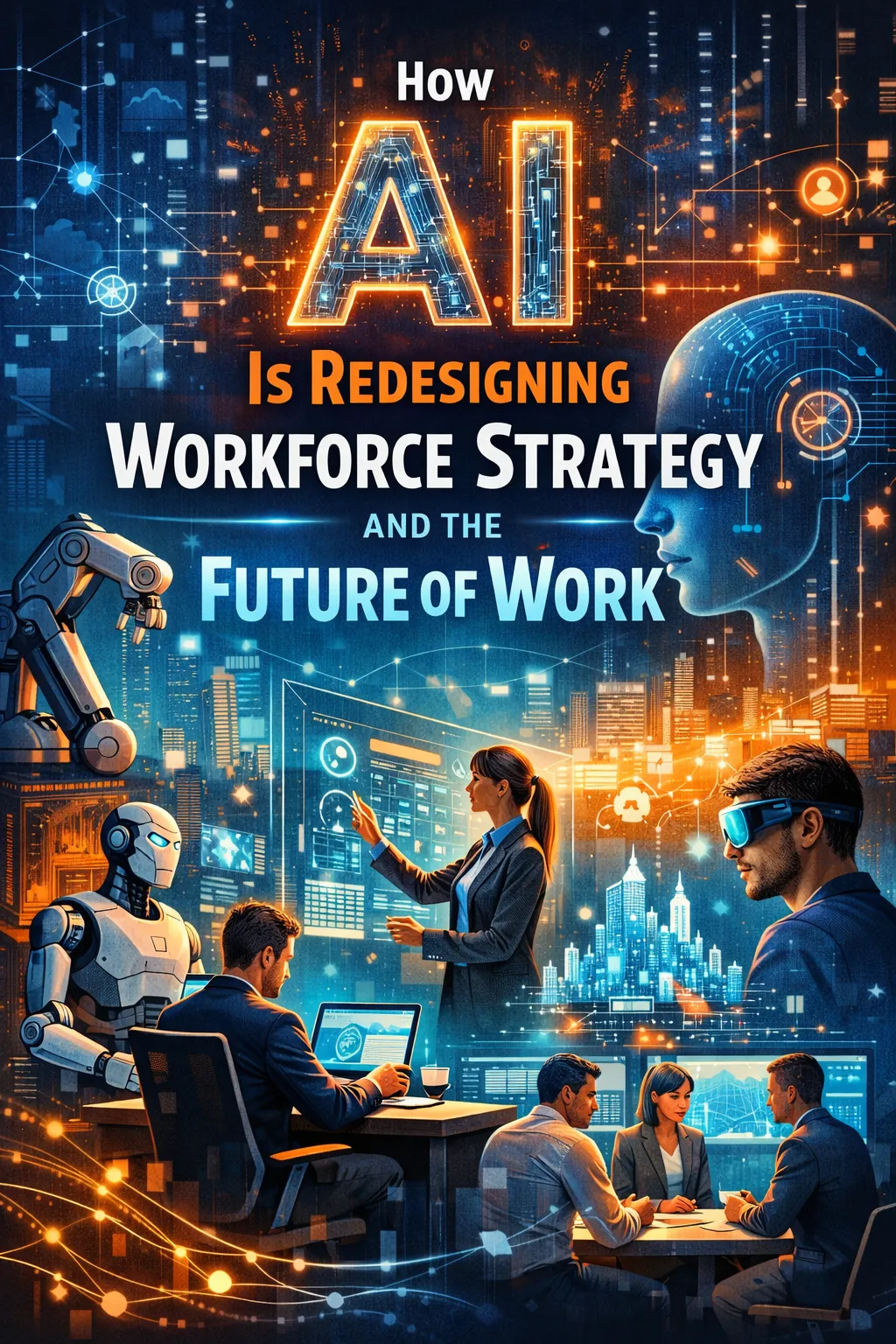
How AI Is Redesigning Workforce Strategy and the Future of Work
Most of the public conversation about artificial intelligence focuses on the wrong question.
Executives, boards, and headlines all ask the same thing: Which jobs will AI replace?
But after speaking with leaders across industries (and recently discussing the topic on the Business Uncomplicated podcast) it’s clear the real transformation looks very different.
Artificial intelligence isn’t simply eliminating jobs. AI is redesigning how work gets done inside organizations.
And that shift is forcing leadership teams to rethink workforce strategy, talent development, and the future of work in ways many companies are not yet prepared for.
How Artificial Intelligence Is Changing Workforce Management and Organizational Workflows
The immediate impact of AI is not widespread job elimination. Instead, organizations are seeing a rapid transformation in how everyday work happens.
Tasks that once required hours of effort, such as data analysis, research, coding, and document drafting, can now be completed in minutes with the help of intelligent systems. AI tools dramatically accelerate the production of information and insights across the organization.
However, the work itself does not disappear.
Instead, the human role evolves. Employees spend less time executing individual tasks and more time interpreting results, connecting insights across teams, guiding decisions, and building relationships with customers and partners.
In practical terms, AI pushes human contribution higher up the value chain.
This is why the future of work is not a story about humans being replaced by machines. It is a story about humans working alongside increasingly capable intelligent systems.
The Rise of the Human + AI Workforce in the AI-Driven Organization
Organizations are increasingly operating with what could be described as a human + AI workforce model.
In this emerging model, AI systems handle activities such as data processing, pattern detection, workflow automation, and repetitive operational tasks. These technologies are extraordinarily effective at executing structured processes quickly and consistently.
Human employees, on the other hand, focus on areas where judgment, context, creativity, and relationship-building matter most. Leadership, communication, interpretation, and decision-making remain fundamentally human capabilities.
The result is not a reduction in the need for people. Rather, the nature of work shifts toward roles that require higher levels of thinking, collaboration, and strategic insight.
For many organizations, this represents the most significant workforce transformation since the beginning of the digital era.
Why AI Transformation Requires Redesigning Work, Not Just Deploying Technology
Many companies still approach artificial intelligence as a technology initiative. They invest in new tools, new platforms, and new automation capabilities in the hope that productivity will naturally improve.
But AI transformation is fundamentally a work design challenge.
Leaders must rethink how work flows through the organization. They must determine which decisions require human judgment, which activities can be automated, and how employees and intelligent systems collaborate effectively.
In other words, AI adoption is not just about implementing technology. It is about redesigning how work is structured, how decisions are made, and how teams interact with increasingly capable digital tools.
Organizations that fail to rethink these structures often find that new technology simply accelerates existing bottlenecks rather than eliminating them.
Why Skills-Based Hiring and Workforce Adaptability Matter in an AI-Driven Future of Work
Artificial intelligence is also changing the capabilities organizations must prioritize when hiring and developing talent.
Traditional hiring models focused heavily on filling well-defined roles tied to specific operational tasks. However, as AI reshapes the nature of work, many of those tasks are increasingly automated.
This means the most valuable employees are those who demonstrate adaptability and learning agility. Organizations are placing greater emphasis on people who can quickly learn new tools, connect ideas across functions, communicate clearly with both colleagues and customers, and apply judgment when systems generate complex information.
Rather than hiring employees strictly for static job descriptions, companies are increasingly looking for individuals who can evolve alongside rapidly changing technologies.
In this sense, the future workforce will be defined less by fixed roles and more by the ability to continuously develop new capabilities.
The Leadership Question Every Organization Must Answer About AI and the Future of Work
The organizations that benefit most from artificial intelligence will not necessarily be the ones that deploy the most technology.
They will be the ones that answer a deeper leadership question: How should humans and intelligent systems work together?
This question requires leadership teams to rethink workforce strategy, operational workflows, decision-making authority, and talent development. AI adoption introduces enormous potential, but the value only materializes when organizations redesign how work actually gets done.
For many companies, this shift will require a level of organizational change that goes far beyond technology implementation.
Assessing Your Organization’s AI Readiness for the Future of Work
As artificial intelligence continues to reshape industries, every leadership team should be evaluating whether their organization is truly prepared for the changes ahead.
That assessment starts with three essential questions. Leaders must determine how AI will change the nature of work inside their organization, which activities should remain human-driven and which can be automated, and whether their workforce has the capabilities required to operate effectively in an AI-enabled environment.
These questions go beyond technology strategy. They address the core structure of how work is organized and executed.
If you are interested in exploring these issues more deeply, our AI Readiness Assessment helps leadership teams evaluate where artificial intelligence can create meaningful operational value, how organizational workflows may need to evolve, and what workforce capabilities will be necessary in the coming years.
AI is redesigning the shape of the workforce. One of the best things you can do is determine how to get ready for it.