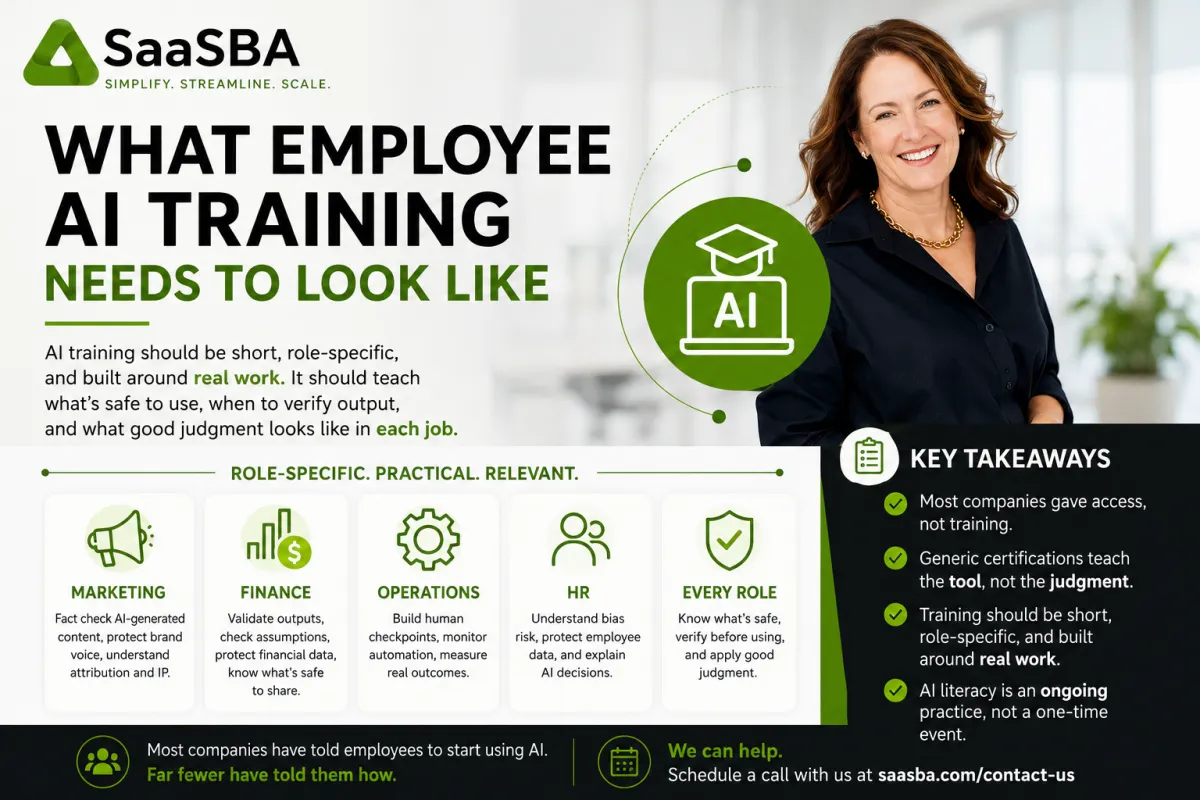
What Employee AI Training Needs to Look Like
AI training should actually look like short, role-specific training built around real tasks in each function. It should cover what data is safe to use, when AI output needs verification, and what good judgment looks like in that particular job.
Key Takeaways
Most companies never trained anyone on AI. They gave employees access and assumed people would figure it out.
Generic certifications teach the tool, not the judgment. A prompt-writing course doesn't teach a finance analyst when to double check a forecasting output, or teach a marketer when an AI-generated claim needs fact checking before it goes external.
AI training should actually look like short, role-specific pathways instead of one course for everyone, built around real tasks in each function, covering what data is safe to use, when output needs verification, and what good judgment looks like in that specific job.
It's not a one-time rollout. AI tools change quickly, and training built once goes stale fast. Treating AI literacy as an ongoing practice, revisited regularly, matters more thangetting the first version perfect.
Most companies have told their employees to start using AI. Far fewer have told them how.
Right now that’s functioning as an AI literacy gap. It's the space between "we've given everyone access" and "everyone actually knows what they're doing." And right now, that gap is wider than most leadership teams realize. A large share of employees are already using AI tools daily, often without any formal guidance on what's safe to share, how to evaluate what the tool gives back, or what "good use" even looks like in their specific role.
The problem is that most companies treat AI literacy as one training, for everyone, all at once. That doesn't work, because what a marketer needs to know about AI is not what a finance analyst needs to know (and neither of those is what an operations manager needs to know.)
Generic AI certifications, whether from a university program or a vendor, tend to teach the tool. They rarely teach the judgment required to use that tool well in a specific job.
Generic AI Training and its Gaps
A certificate that teaches prompt writing is useful. It's also not the same thing as knowing when to trust an AI-generated output and when to double check it. It doesn’t tell you what data is safe to paste into a chat window and what isn't, or how a specific workflow in your specific department should change because of what AI can now do.
The real definition of AI literacy is not simply knowing how a tool works, but knowing what it can and can't do, recognizing when its output needs verification, and understanding the judgment calls specific to your own role.
A generic course can teach the first part. It almost never teaches the second and third.
What AI literacy should look like, by function
AI Literacy in Marketing
Marketing teams are often the earliest and heaviest AI adopters, which means they're also the most exposed to a specific risk: output that sounds right, but isn't.
AI literacy for marketing means knowing how to fact check AI-generated content before it goes external, how to keep brand voice consistent when a tool is doing first drafts, and where copyright and originality boundaries actually sit. It also means understanding attribution and campaign data well enough to know when an AI tool's "insight" is a real pattern versus statistical noise.
AI Literacy in Finance
Finance deals in numbers people trust by default, which makes AI literacy here a matter of discipline, not just skill.
The core competency is output validation: knowing that a forecasting or scenario modeling tool can produce a confident-sounding number that's still wrong, and building in the habit of checking assumptions before a figure makes it into a board deck. Finance AI literacy also means understanding data classification: what financial data is safe to run through an external tool, and what needs to stay inside approved, governed systems.
AI Literacy in Operations
Operations teams tend to use AI for process automation and workflow optimization, where the risk is a bad decision embedded silently into a repeatable process.
AI literacy for ops means understanding where automation should have a human checkpoint, how to spot when an automated process is quietly drifting from what it was designed to do, and how to evaluate whether an AI-driven change to a process actually improved the outcome or just made one step faster.
AI Literacy in HR
HR sits closest to the highest-stakes AI use cases: hiring, performance evaluation, anything touching employee data.
Literacy here means understanding bias risk in AI-assisted decisions, knowing what employee data can and can't be used in a given tool, and being able to explain to an employee or a regulator how an AI-influenced decision was actually made.
Building this internally (without a training department)
Most mid-market companies don't have a dedicated L&D function built for this. Luckily, they don't need one to get this right.
A few things matter more than a big program:
Start with role-based pathways instead of one-size-fits-all training.
The goal is a short, function-specific set of guidelines. What tools are approved for this role? What data rules apply? What "verify before you use it" means in this specific job?Make it experiential, not theoretical.
People learn AI judgment by using AI on real work, with feedback, not by watching a generic video. The most effective training tends to be hands-on: real examples from the actual tools your team uses, not abstract case studies.Reflect existing skill and responsibility.
A senior finance analyst and a new hire need different depth. Literacy training should build on what someone already knows how to evaluate in their role, not start from zero for everyone.Revisit it.
AI tools and their capabilities change quickly. A training built in January can be outdated by the summer. Treat this as an ongoing practice, not a one-time rollout.
The takeaway
"Push AI" was a popular mandate after 2023, but it’s not training plan. Most companies are only now discovering the gap between access and competence, which is where the real risk lives.
Closing the gap requires accepting that AI literacy isn't one skill, but a different skill in every function – and then building training that actually reflects that.
If your AI roadmap includes broad employee access but no role-specific training plan, that's worth addressing before adoption scales further, not after.
We can help. Schedule a call with us, and we can identify your next steps.