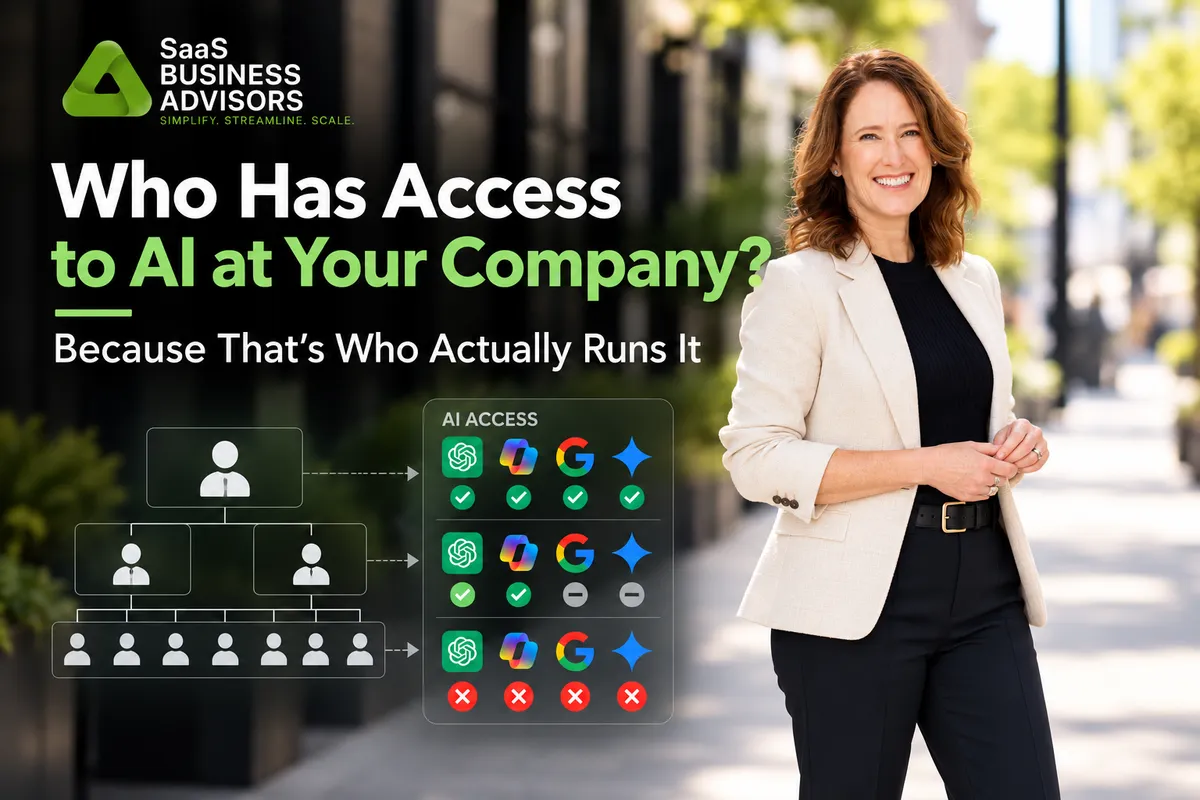
Who Has Access to AI at Your Company?
Because That’s Who Actually Runs It
Key Takeaways |
|
A few months ago, a client gave me full access to every AI tool in their enterprise stack. Copilot, no restrictions, the works. Then I found out the delivery team I was actively serving, the people doing the hands-on work every single day, didn't have the same access I did.
It was awkward. But worse than that, it caused real damage.
Access Is the Leading Indicator. Adoption Is the Lagging One.
Most companies start their AI conversation with adoption – specifically, an adoption survey.
This is something that goes out to the entire team to gather important data: How many people are using the tool, how often, what's the sentiment. Those are useful numbers, but they're all downstream of a question people neglect asking first:
Who actually has access, and does it match who's doing the work?
If it doesn’t, that gap quickly becomes the reason the story leadership tells and the reality on the ground isn't lining up. Your team will begin talking past each other immediately.
Run this audit before the adoption survey. It's faster, and it tells you something the survey can't.
I want to be specific about why this order matters. An adoption survey tells you what people are doing with what they've already got. It cannot tell you about the work being avoided, delayed, or routed around a tool because the person doing it never had the access to do it the sanctioned way in the first place. You will not find that gap by asking people how satisfied they are with the AI tools available to them. You find it by asking who has which tools, cross-referenced against who is actually closest to the work those tools are meant to support.
Why This Happens Even in Well-Run Organizations
It would be easy to treat this as a symptom of disorganization, but I've seen it happen inside genuinely well-run companies, too.
Access usually gets granted the first time somebody asks for it (and has the standing to ask.)
A director requests a license for a pilot. A leadership team gets access as part of a platform rollout because they're the sponsors. Neither of those is unreasonable in the moment. But six months later, the pilot became the standard, the leadership access never got reviewed, and nobody circled back to ask whether the people actually doing the work day to day ever got the same thing.
This is how a perfectly rational sequence of individual decisions produces an outcome nobody would have designed on purpose. Nobody sat in a room and decided the delivery team should have less access than the person overseeing them. It just accumulated that way, one reasonable approval at a time, until the org chart and the access list stopped agreeing with each other.
Employees Will Solve the Gap Whether You Ask Them To or Not
If someone on your team needs AI to move faster and you haven't given them a sanctioned way to do it, they will not wait for procurement. They'll open a personal account and get the work done, because their time is worth more to them than the risk of using a tool nobody approved.
This isn't a compliance failure but a rational response to an incentive structure that rewards output and offers no sanctioned path to get there faster. When those two things conflict, speed wins every time, for every employee, in every company I've worked with.
I think leaders sometimes hear this and assume the answer is a training session about the risks of unsanctioned tools. It rarely changes the underlying math. Someone can fully understand the risk, agree it's a real risk, and still make the same choice tomorrow, because the risk is diffuse and future, and the deadline is specific and today. You are not going to out-argue that with a slide about data governance. You have to change the actual choice available to them, not just their awareness of the choice they're already making.
The fix isn't a firmer policy memo. It's closing the gap before your team closes it for you, on their own terms, with your data.
The Cost Sits on Both Sides of the Ledger
Leadership tends to treat wider AI access as a cost line: more licenses, more oversight, more training hours. That's real, and worth budgeting honestly.
What gets missed is the cost of the alternative. An employee routing company data through a personal AI account is working outside every enterprise control you have, with no audit trail and no visibility for you. That's not a future risk. It's very likely already happening somewhere in your organization right now.
Weigh both sides before deciding wider access is too expensive. In most cases I've seen, the cost of the workaround, once it surfaces months later and outside your control, is considerably higher than the cost of the tool would have been.
There's a governance dimension here too, and it's worth naming directly. Training that ends with someone saying they understand the policy has not actually reduced your risk. It has produced a record that a conversation happened. Real governance asks people to demonstrate understanding, not just confirm it. Have them walk through where the sensitive data actually lives in a system they touch every day. If they can't, the training didn't take, no matter what the completion tracker says. Access and governance move together. Expanding one without tightening the other just moves your risk somewhere less visible.
What an Access Audit
Before your next AI tooling decision, put these questions in front of your leadership team directly:
Do the people closest to the work have the same AI access as the people managing them?
If someone needs to move faster than your approved process allows, do they have a sanctioned path, or only a workaround?
Where has access been granted by default (a title, a department, a request that got approved once) rather than by a documented decision?
Who is reviewing this list, and on what cadence?
None of these are technology questions. They're questions about whether your organizational structure matches the speed your people are already trying to move at.
What This Reveals About Leadership
An access gap is rarely a security failure at the root. It's usually a visibility failure. Leadership assumes access mirrors org structure, and it doesn't, because access decisions get made in isolation, one request at a time, by whoever happened to be in the room when the tool got purchased.
I'd go a step further. How an organization handles access is a fairly reliable proxy for how it handles decision rights generally. Companies that are careful and deliberate about who gets to decide what tend to be careful and deliberate about who gets which tools, for the same underlying reason: they've built the habit of asking who owns this, rather than defaulting to whoever asked first or whoever holds the more senior title. Companies where access sprawls unevenly usually have the same pattern showing up elsewhere, in how projects get approved, in who gets pulled into which meetings, in whose priorities get funded first. The access list is just the version of that pattern you can actually go look at and count.
Closing that gap starts with an honest audit of who has what, and why. It's an uncomfortable exercise. It is also considerably cheaper than finding out the hard way, after the workaround has already become the norm.
If you want a clearer, structured read on where your organization stands, not just on access but on governance and readiness more broadly, set up a free call with us. That's usually where the real conversation starts.
FAQ
What is an AI access gap? It's the mismatch between who has been granted AI tool access inside an organization and who is actually doing the work that access is meant to support. It typically forms gradually, through individually reasonable approvals, rather than through a single deliberate decision.
Is an AI access gap a security issue? It can become one. When employees don't have sanctioned access to the tools they need, many will use personal accounts instead, which removes any enterprise-level control, audit trail, or visibility into how company data is being used.
How do we find out if we have an access gap? Run an access audit before an adoption survey. Compare who has AI tool access against who is closest to the work day to day, and look specifically for access granted by default (through a title, a pilot, or a one-time approval) rather than through a documented, revisited decision.
Will more training fix the access gap? Not on its own. Employees who route around access limits are usually making a rational trade-off between a specific deadline and a diffuse future risk. Training raises awareness of the risk, but it doesn't remove the incentive to take the shortcut. Closing the actual access gap does.