Why Leadership Is the Biggest Factor in Enterprise AI Transformation Success
Most AI transformations fail because of failures in leadership, not because of failures in the technology itself. CEOs and COOs must practice stronger, more engaging leadership practices throughout a transformation if they want to see ROI on their projects.
Sadly, many don’t, and the results show it.
Key Takeaways
Enterprise AI transformation failure is almost never about the technology. It is about the leadership vacuum behind it.
The single biggest predictor of AI adoption success is whether leadership is unambiguous about direction, committed through the discomfort, and visible throughout the entire journey, not just at launch.
The same technology, the same budget, and the same vendor can succeed in one organization and fail in another based entirely on who is running the rollout and how committed they are.
The right question before any AI implementation is not whether your technology is ready. It is whether your leadership is ready to sustain the change.
AI Transformation Failure, and Getting Uncomfortable
Every failed AI transformation has a postmortem. And in nearly every one, the technology gets the blame.
The budget was too small. The vendor overpromised. The timeline was too aggressive. The data was not clean enough. The integration was more complex than expected.
In twenty years of working with large enterprises on some of the most complex AI implementations and digital transformations imaginable, I have rarely seen technology be the actual problem. What I have seen, over and over again, is that leadership problems are the real center.
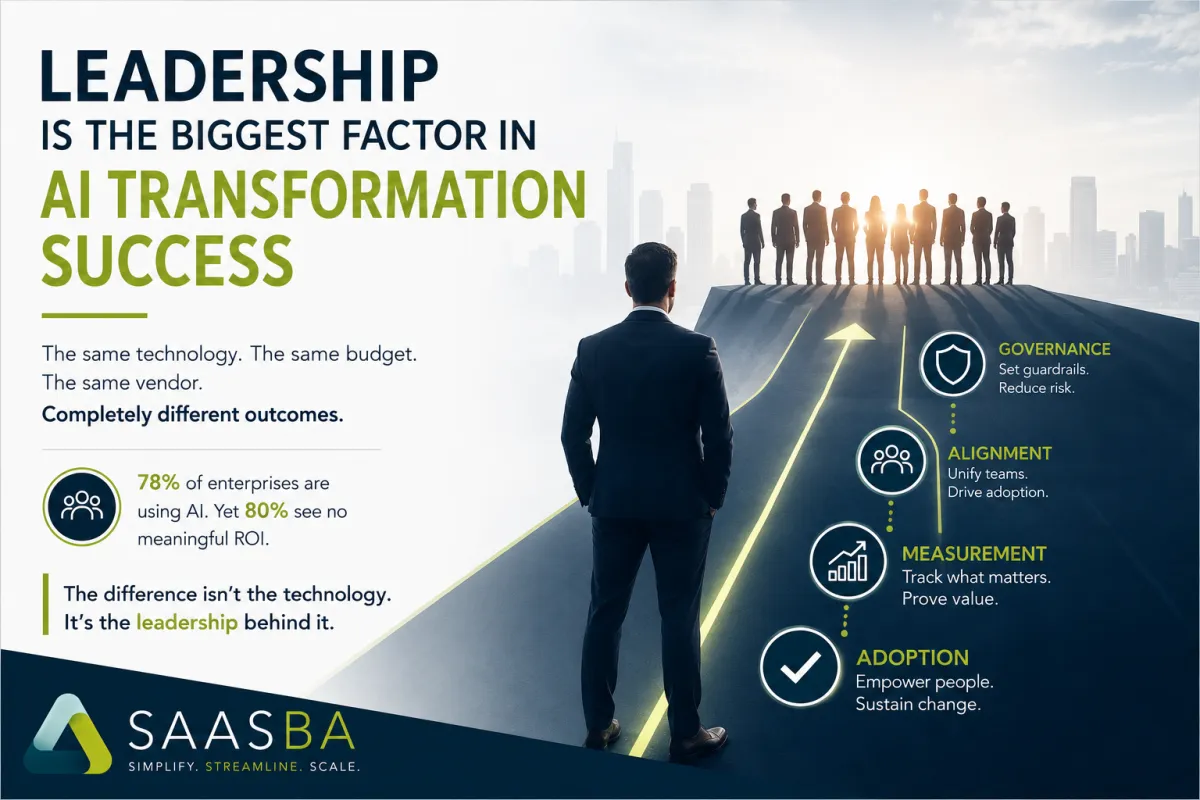
The statistics bear this out. Right now, 78% to 80%of enterprises are using AI in some form. Yet 80% report seeing no meaningful ROI. Nine out of ten AI use cases never scale beyond a pilot.
The average enterprise AI ROI sits at just 5.9% against budgets that already represent 10% of total spend. This is not a technology problem. If it were, we would not see such dramatic variation in outcomes across organizations using identical tools.
What explains that variation? In almost every case, it comes down to one thing: the quality and commitment of the leadership driving the transformation.
What Committed Leadership Looks Like in AI Transformation
Most leaders believe they are being clear. They announce the initiative, fund the project, show up to the kickoff meeting and give a speech about innovation and the future. And then they step back and let the project team handle it.
Six months later, they want to know why adoption has stalled.
True leadership commitment in an enterprise AI transformation is a sustained, unambiguous signal to the entire organization that there is no path back to the old way of doing things.
It means acknowledging openly that there will be a learning curve. That some processes will feel harder before they feel easier. That people will be uncomfortable, and that the discomfort is not a reason to stop.
Good leadership here means being able to say, “There will be tears, and we are still going in that direction.”
That kind of clarity is rarer than it sounds, and its absence is the single most common reason AI implementations fail to deliver on their promise.
The Most Important Variable In A Rollout
I have seen the same technology succeed in one organization and fail in another. Same platform. Same budget. Same implementation partner. Completely different outcomes.
When I look at what separates those outcomes, the answer is almost always leadership. Specifically, whether the person or team responsible for the transformation drew a hard line and held it.
A powerful example of this comes from a conversation we had with Kelly Bianchi on the Business Uncomplicated podcast.
Kelly spent years bringing technology into the auto auction industry, one of the most traditionally resistant industries imaginable. She described working with multiple independent auctions and watching the same technology produce wildly different results across organizations.
The ones that succeeded had one thing in common: Leadership made a clear decision, communicated it to the entire organization, and removed the alternative.
In one case, a department simply stopped taking arbitrations by phone. They eliminated every other channel. They said: this is the path. And when everyone started following the path, they got the results.
The ones that failed kept the old process running alongside the new one. They positioned the technology as an option rather than a direction. And because people always default to what they know, the new system became just another thing on the list. Adoption stalled, the technology got blamed, and the organization went back to what it was doing before.
The technology was identical. The leadership was not.
The Three Leadership Failure Modes in Enterprise AI Adoption
After working through dozens of enterprise AI implementations and digital transformations, I have identified three patterns that consistently undermine even the most well-funded and technically sound initiatives.
The Absentee Sponsor
This leader funds the project and disappears. They show up for the announcement and the final presentation. Everything in between is delegated. The project team has budget and a mandate but no executive air cover when the organization pushes back. And organizations always push back.
Without visible, sustained leadership support, resistance wins by default. The project loses priority. The initiative dies without anyone officially killing it.
The Reluctant Convert
This leader says all the right things publicly but privately keeps the old process running as a safety net. They tell their team to use the new system while continuing to request reports in the old format. They attend the AI strategy meetings while maintaining parallel workflows that allow everyone to avoid the new tools without consequence.
The message the organization actually receives is clear: this is optional. And optional never gets adopted.
The Complexity Mirror
This is perhaps the most damaging pattern, and it is also the most well-intentioned. This leader is genuinely trying. They have taken on the AI transformation with real commitment. But they are overwhelmed by it, and they show it. They talk about how complicated the integration is. They share their own confusion about the tools in team meetings.
They inadvertently signal that this is hard and uncertain, even as they push forward. So, they lose trust with their own teams, who lose belief in the project.
Leadership is a mirror. Whatever you project, your organization reflects. A leader who radiates anxiety about a transformation is training their entire team to feel the same way. The result is a workforce that approaches the new system with dread rather than curiosity, and adoption suffers accordingly.
What the Right Leader Does Differently
Effective AI transformation leadership is about creating the conditions in which change can actually take hold. The leaders I have seen drive successful enterprise AI adoption consistently do four things differently.
They communicate the why before the what. Before anyone knows which tools are being implemented or what the rollout timeline looks like, they understand why this change matters, what problem it solves, and what the organization looks like on the other side of it. People do not resist change. They resist change they do not understand.
They remove the alternative. Successful AI transformation leaders do not offer the new system as an option. They make it the only path forward while providing the support people need to walk it. This is not about being heavy-handed. It is about being clear. Ambiguity is the enemy of adoption.
They stay visible through the messy middle. Launch day is easy. Everyone is excited. The hard part is the weeks and months that follow, when the novelty has worn off and the friction has set in. The leaders who drive lasting adoption are the ones who remain visibly engaged during this period, checking in, removing obstacles, and reinforcing that the direction has not changed.
They treat early failure as data, not defeat. Every AI transformation hits bumps. Processes that seemed straightforward turn out to be more complex. Integrations that looked clean on paper require rework. Teams that were enthusiastic at launch hit walls they did not anticipate. Leaders who respond to these moments with curiosity and problem-solving create organizations that learn. Leaders who respond with blame or retreat create organizations that revert.
The Human Side of AI Change Management
There is a reason people resist new technology, and it is not stubbornness. It is fear. Specifically, it is the fear of becoming less valuable.
When someone has spent years mastering a process, developing deep expertise, and building their professional identity around knowing how things work, asking them to start over is not a neutral request. The moment they stop being the expert in the room, they feel like they are becoming an idiot. That feeling is powerful, and it will not be overcome by a training session or a feature overview.
Kelly put it this way: the most common thing people said to her after working through a technology transition was that they appreciated not being made to feel stupid. That simple observation contains an entire philosophy of effective AI change management.
People do not need to be dazzled by the technology. They need to feel respected throughout the process of learning it.
Effective AI adoption strategy starts not with the technology but with the question: what are people afraid of losing? Answer that question honestly, and you have the foundation for a change management approach that actually works.
The Question Every Leader Should Be Asking Before an AI Implementation
Most pre-implementation conversations focus on the technology. Which platform, which vendor, which use cases to prioritize, what the integration architecture looks like. These are important questions. They are not the most important question.
The question that determines whether an enterprise AI transformation succeeds or fails is this: Are we, as a leadership team, ready to sustain this change through the discomfort that is coming?
Because discomfort is coming. That is not pessimism. It is the reality of any meaningful organizational change. Processes will need to be redesigned before AI can be embedded in them. Teams will need to unlearn habits they have practiced for years. There will be a period where the new way feels harder than the old way, and the temptation to retreat will be real.
The organizations that make it through that period and come out with AI that actually delivers measurable business outcomes are the ones led by people who decided, before the project started, that they were not going to flinch.
That decision, made before a single line of code is written or a single tool is selected, is the most important factor in enterprise AI transformation success.
It is a leadership decision, not a technology decision.
Closing Thoughts
Transformations fail when no one stands up to say: this is where we are going, this is why it matters, and we are not going back. That is the job.
In twenty years of sitting across from leadership teams navigating digital transformation, I have never seen a well-led initiative fail because of the technology. I have seen plenty of well-funded initiatives fail because of the leadership.
If you are preparing for an AI transformation and you want to understand your real risk, start with your leadership team. Ask honestly whether they are ready to be clear, to stay visible, and to hold the line when it gets hard.
If the answer is yes, your technology choices matter much less than you think. If the answer is no, no technology choice will save you.